
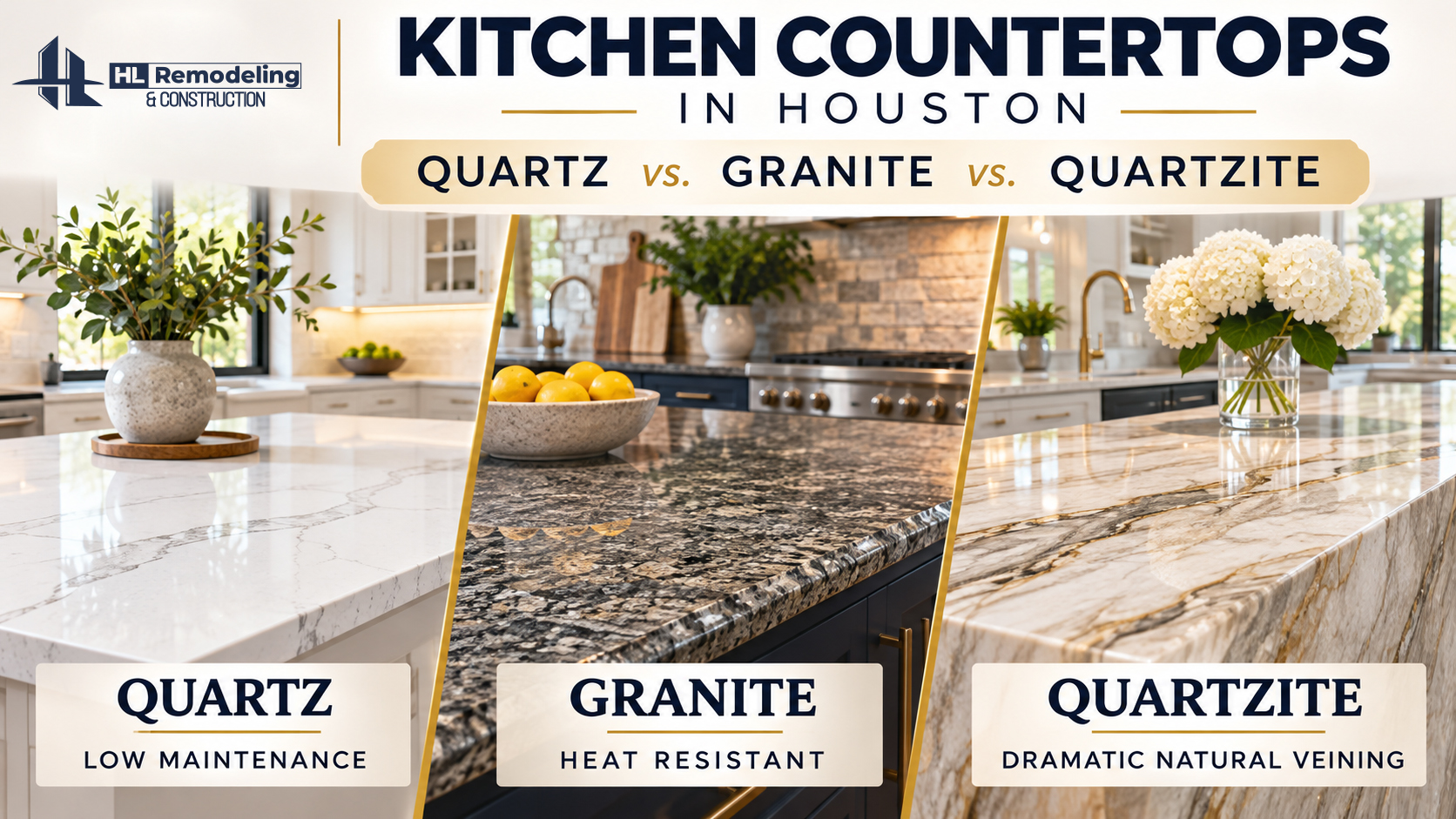
For a Houston kitchen remodel, quartzite or premium granite is the better pick if you want natural stone with real heat resistance and long-term value, and quartz is the better pick if you want low maintenance and a consistent look. The deciding factors are how much heat your cooktop zone sees, how much sealing you will tolerate, and how much veining variation you will accept. Choosing among kitchen countertops is not a matter of taste alone: it comes down to how each stone behaves under Houston humidity, afternoon sun, and a real cooking schedule, and all of that is knowable before you buy. We recommend settling the stone before cabinet and layout decisions lock in during a full kitchen remodeling project, because slab size drives island dimensions and seam placement.
Key Takeaways
- Houston installed prices run roughly $50 to $150 per square foot for quartz, $40 to $140 for granite, and $75 to $210 for quartzite, and the spread comes from slab grade, edge profile, and waterfall legs.
- Quartz handles Houston humidity best and needs no sealing, but its resin binder has heat and sustained-UV limits that granite and quartzite do not share.
- Granite and quartzite both need periodic sealing, and quartzite carries a mislabeling risk that an acid and scratch test can expose before you buy.
- Templating happens only after cabinets are set, so picking and tagging your exact slab early protects the schedule, especially in hurricane season.
Which Material Fits Your Houston Kitchen at a Glance?
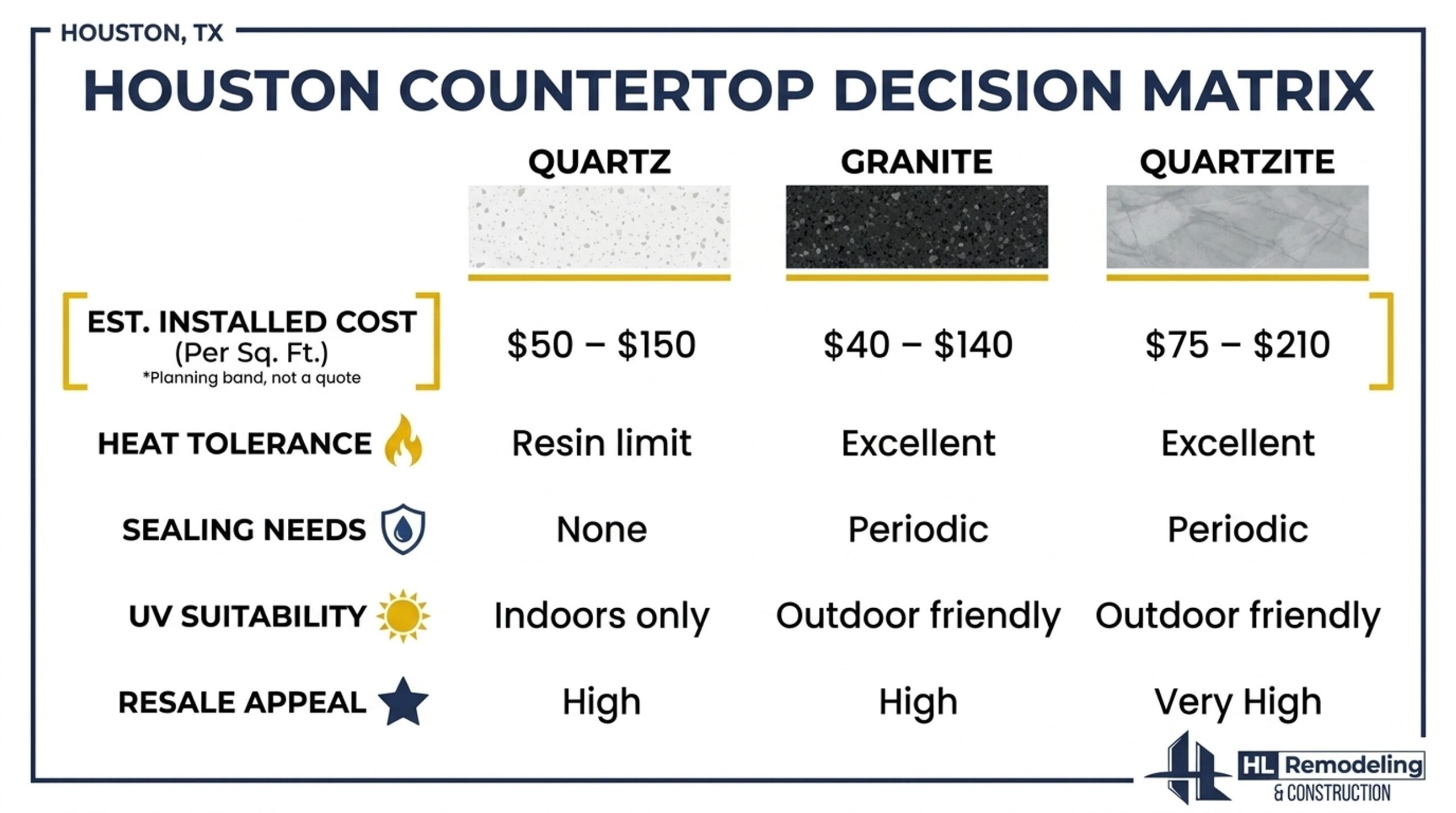
Start with the side-by-side view. The table below uses installed Houston ranges pulled from published fabricator guides, and those guides disagree with each other. Treat the numbers as a planning band, not a quote. Slab grade, edge profile, sink cutouts, and waterfall legs move the final figure more than the category does.
| Factor | Quartz | Granite | Quartzite |
|---|---|---|---|
| Installed cost per sq ft (Houston) | $50 to $150 | $40 to $140 | $75 to $210 |
| Mohs hardness | About 7 (resin-bound) | 6 to 7 | About 7 |
| Heat tolerance | Limited by resin | Excellent | Excellent |
| Stain resistance | Very high (non-porous) | Good when sealed | Good when sealed |
| Sealing needs | None | Periodic | Periodic |
| UV and outdoor suitability | Indoor only | Good | Good |
| Resale appeal | Strong, consistent | Strong for exotic slabs | Strongest for statement slabs |
| Typical lead time after template | 1 to 2 weeks | 1 to 2 weeks | 1 to 3 weeks |
Some quartz lines carry NSF/ANSI 51 food-zone certification and GREENGUARD Gold air-quality certification. Not every line does, so confirm both per product. If you want a second set of eyes on a spec sheet before you commit to a slab, we are glad to look it over with you.
How Much Do Quartzite, Granite, and Quartz Countertops Cost Per Square Foot Installed in Houston?
Most Houston buyers should plan on $50 to $150 per square foot for quartz, $40 to $140 for granite, and $75 to $210 for quartzite, installed. The ranges overlap because published sources conflict. Quartzite alone is quoted anywhere from $75 to $130 up to $90 to $210, depending on the fabricator. Your number moves with slab grade, mitered waterfall legs, edge profile, sink and cooktop cutouts, and demo of the old surface.
Is Quartz the Right Call If You Want Zero Surprises?
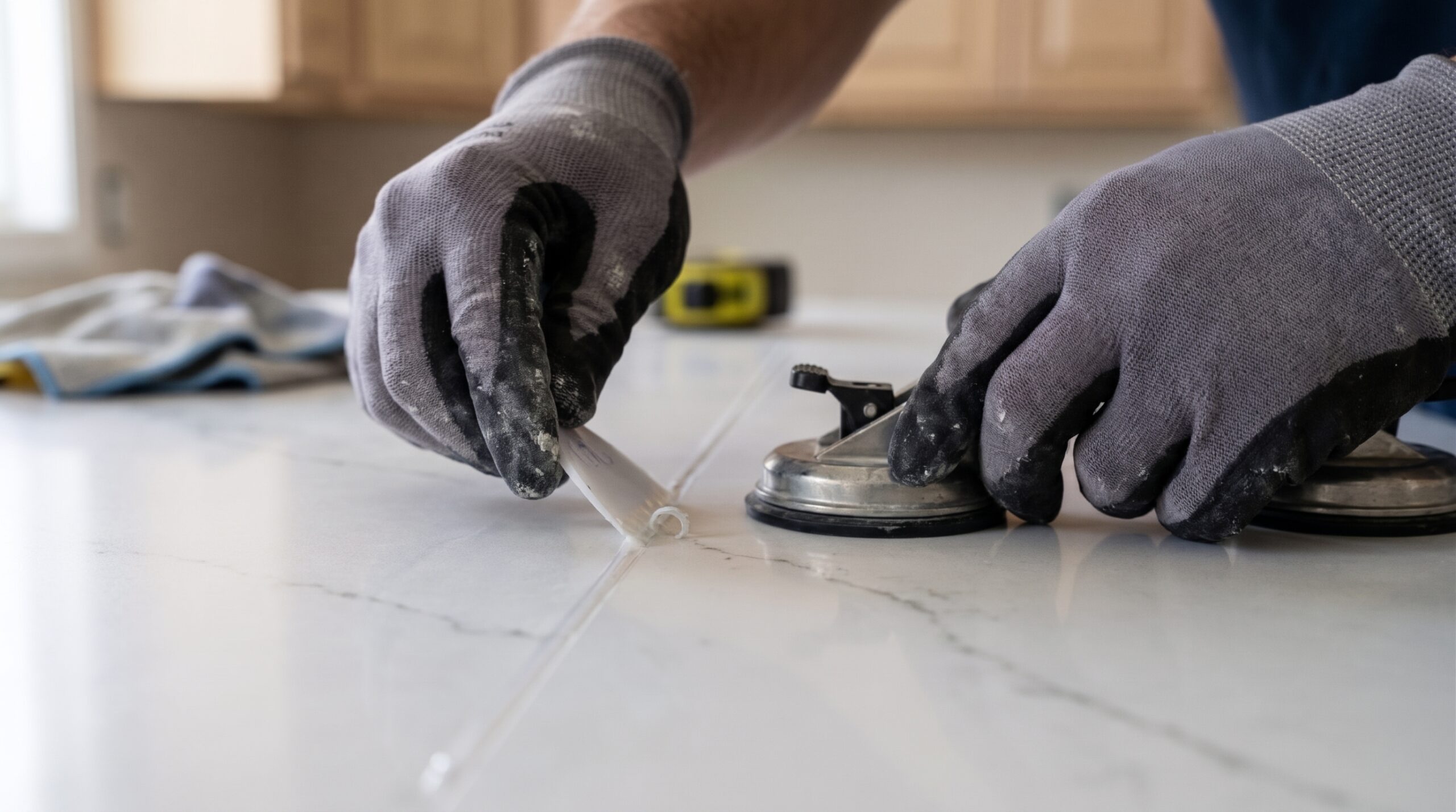
Quartz countertops are engineered from roughly 90 percent ground quartz bound with polymer resin, which makes them non-porous and uniform. Major brands include Caesarstone, Cambria, and Silestone by Cosentino. Cambria Brittanicca is the benchmark Calacatta-look design for buyers who want marble drama without marble upkeep. Houston quartz typically installs in the $50 to $150 per square foot range, with premium veined lines at the top.
The surface never needs sealing and resists red wine and coffee, so it is a natural fit for busy families. It also looks the same from one slab to the next, which matters on a long island where two natural slabs might not match. Upkeep is soap and water, and if you want easy cleaning, quartz is hard to beat. That is the main reason quartz sells so well to homeowners in newer Sugar Land and The Woodlands kitchens.
Does Quartz Countertop Fade or Discolor in Sunlight or Heat?
Quartz can yellow under sustained direct UV and can scorch or discolor from hot cookware. Caesarstone says indoor sunlight behind glass rarely damages quartz. Cambria does not recommend outdoor installation, and most warranties exclude heat damage. In Houston, the trouble spots are a west-facing breakfast nook or a lanai-side prep zone.
When Quartz Wins and When It Doesn’t
Quartz is ideal for an interior island, a busy prep area, and anyone who does not want a sealing schedule. It is a poor fit beside an outdoor kitchen, in a sun-drenched corner, or directly next to a range where pans come off the burner and onto the stone. Use trivets and the surface lasts. Skip them and the resin shows the damage.
Does Granite Still Earn Its Place in a Houston Remodel?
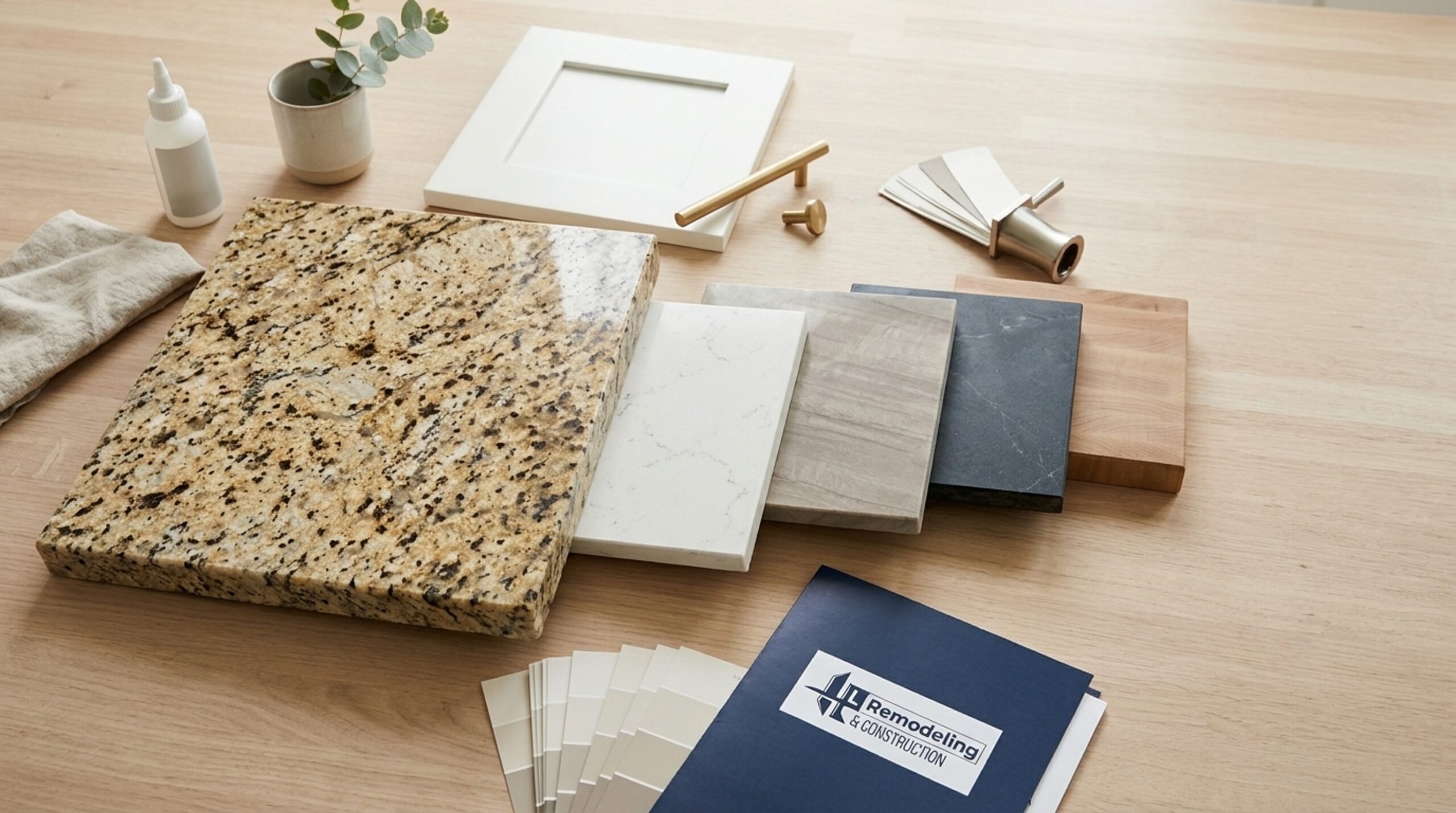
It does, through heat resistance, UV stability, and a long track record. Granite is igneous natural stone, ranks around 6 to 7 on the Mohs hardness scale, and shrugs off a hot skillet that would mark quartz. Absolute Black gives a dense, near-solid look. Blue Pearl brings silvery-blue flash that suits cool palettes. Granite runs from builder-basic to exotic slabs that cost as much as quartzite.
Houston installed pricing for granite countertops runs about $40 to $140 per square foot, with the top of that range reserved for exotic patterns. Established homes in Bellaire and Memorial often have granite still performing after 15 or 20 years. The risk sits in the pattern, because a large island can show slab-to-slab variation that quartz avoids.
Granite and quartzite both handle sun better than quartz, which makes them the safer match near large west-facing windows and patio doors. If your kitchen gets heavy afternoon light, natural stone holds up to sun exposure better than quartz does. Natural Stone Institute guidance applies to both stones: use a pH-neutral cleaner and seal on a schedule.
Do Granite and Quartzite Countertops Need to Be Sealed, and How Often?
Yes. Granite and quartzite both need sealing, typically every one to three years depending on the stone and the sealer. Sources range from every six months to every three years, so test your actual slab instead of trusting a flat rule. The Natural Stone Institute water test works: drop a tablespoon of water on the surface and wait 30 minutes. If the stone darkens, reseal. Houston’s humidity, which sits near 75 percent on average according to NOAA normals, pushes us toward annual checks. Sealing is the main maintenance cost of natural stone, and homeowners who skip it are the ones who end up with stained surfaces.
Where Granite Falls Short
Granite chips at thin edges and can show inconsistent veining across a big island. Plain builder-grade granite also reads as dated to buyers in the River Oaks price range, and that hurts perceived value more than the material does. If you choose granite, choose a slab with character and pay attention to the edge.
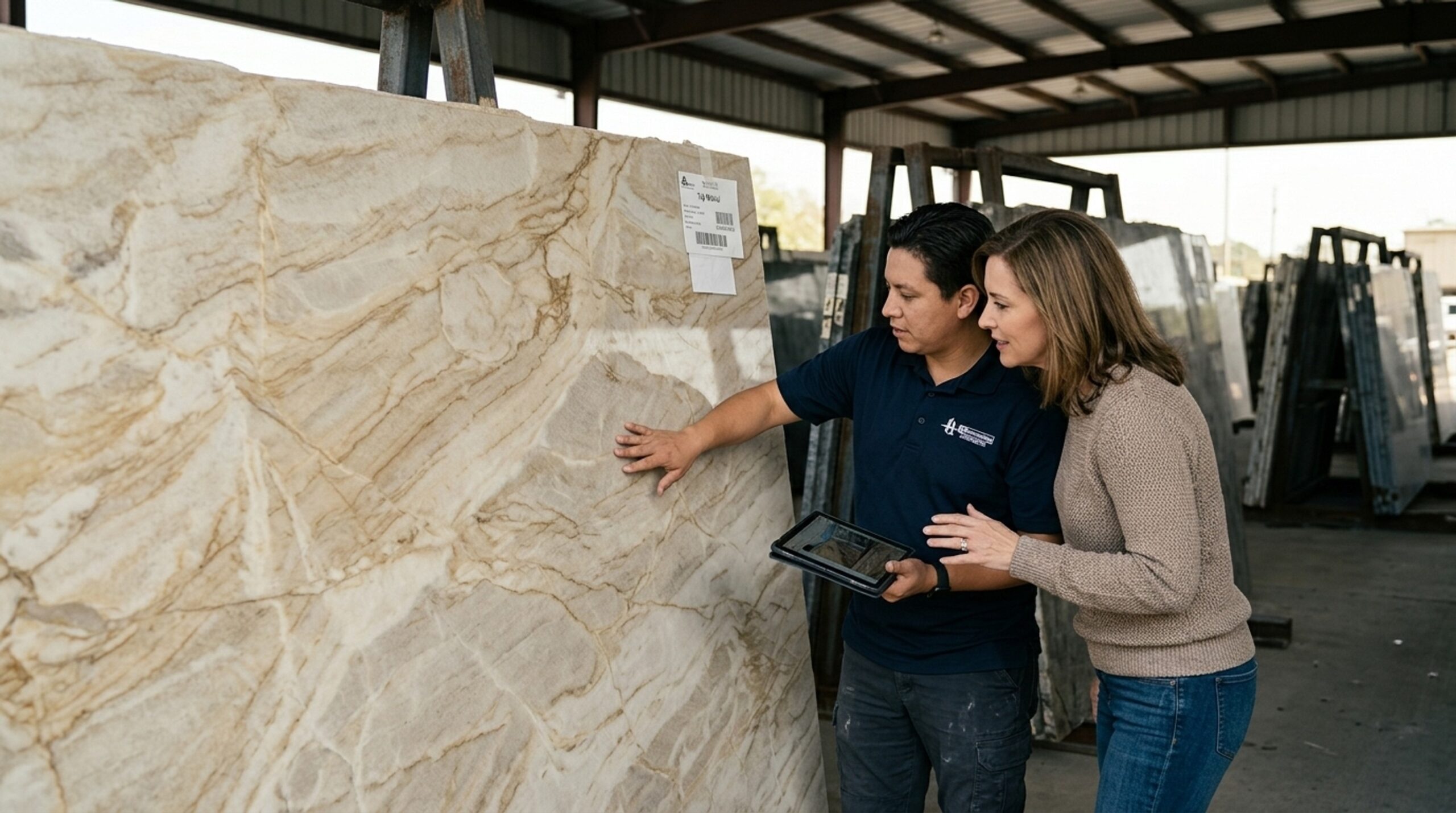
Is Quartzite Better Than Granite or Quartz for Kitchen Countertops?
Quartzite is harder and more heat tolerant than quartz and often more striking than granite, but it costs more and needs sealing. Whether it is better depends on how much premium and upkeep you will accept for marble-like veining that holds up to cooking.
Quartzite is natural stone formed when sandstone is fused under heat and pressure, and it ranks around 7 on the Mohs scale. That sandstone origin sets it apart from granite, which cools from magma. If you are comparing countertop materials, quartzite is another type of natural stone that rivals marble for looks while outperforming it on durability. Popular slabs include Taj Mahal, White Macaubas, and Sea Pearl, all stocked at Houston yards such as Arizona Tile, MSI, and Daltile. Houston quartzite typically installs between $75 and $210 per square foot.
What Quartzite Costs in Houston and Why the Range Is Wide
A rare, heavily veined slab can push an installed quartzite counter well above the quartz range. Houston sources put the premium over granite at roughly $15 to $70 per square foot. Pricing swings on slab rarity, thickness, and fabrication difficulty, because very hard stone wears blades quickly. Ogee edges may not be possible on some quartzite, so confirm the edge you want before you fall for a slab.
Is Quartzite Worth the Premium?
It is, if you cook hard, want a white or soft-gray marble look, and accept annual sealing. It is not, if you want zero maintenance or a tight budget. In River Oaks and West University, a well-chosen quartzite island is often the piece buyers remember.
How Do You Tell True Quartzite From Soft Stone Sold as Quartzite?
Some stones sold as quartzite are really dolomitic marble or other soft stone, and they can etch within weeks. Super White and Fantasy Brown are two names that regularly cause confusion. The mistake is expensive, because the fix is a replacement.
You can check a slab yourself before you commit. Ask the yard for a small off-cut and run these tests:
- Scratch a piece of glass with the stone. True quartzite scratches glass, while softer marble does not.
- Place a drop of lemon juice or mild acid on a polished off-cut and wait several minutes. A dull spot means the stone etches.
- Watch how quickly a water drop absorbs. Fast absorption signals a more porous stone that needs more careful sealing.
Mohs hardness measures scratching, not acid resistance. Passing the scratch test alone proves nothing, which is why the acid test matters.
Questions to Ask a Fabricator Before You Commit
Ask for the geological name of the stone, the quarry origin, and any test data on absorption and hardness. Ask whether the supplier will state the classification in writing. A fabricator who answers cleanly is a good sign. One who dodges is a warning. During our selection days we run these checks and tag the exact slab, so what gets cut is what you approved. If a slab is already in your cart and you want a second opinion on it, bring the slab number and we will go through it with you.
What Houston Conditions Change the Countertop Decision?
Houston’s climate changes how each stone behaves. Humidity speeds sealant breakdown on natural stone. August averages around 95 degrees, and Texas sun pours through west-facing glass and open patio doors. Those facts tilt kitchen countertops toward quartz for interior prep zones and toward granite or quartzite near sun and outdoor cooking.
Humidity matters most at the sink and beverage station, where porous stone sees constant moisture. Heat and UV matter most near large windows and outdoor-kitchen adjacency, where quartz resin is the weak link. A north-facing kitchen with deep eaves is a very different environment from a west-facing one with floor-to-ceiling glass.
Planning Around Hurricane-Season Backlogs
Hurricane season, roughly August through October, can slow slab shipments through the Port of Houston and stretch fabricator schedules. Special-order quartzite and jumbo slabs are the most exposed. We advise choosing and holding your slab before demo, so the schedule never depends on a shipment you cannot control.
How to Inspect Slabs in Person at a Houston Stone Yard
Visit the yard and look at the full slab, not a sample chip. MSI Surfaces, Daltile and Arizona Tile, TopStone, and independent yards like Terra Granite let you view slabs in natural light. Check that the veining scale suits your island and look for fissures and resin repairs. Photograph both sides, then write down the slab number so that exact slab is the one cut.
Which Countertop Material Adds the Most Resale Value to a Houston Home?
No material wins outright. Natural-stone statement slabs tend to carry the strongest perceived value in high-end Houston neighborhoods, while quartz protects value through consistency and low wear. According to the Remodeling Cost vs. Value Study, a minor kitchen remodel recoups a high share of its cost at resale, which suggests condition and overall kitchen quality matter more than the category. In River Oaks, Memorial, West University, Bellaire, The Woodlands, and Sugar Land, buyers expect quartz or granite as a baseline. Differentiation comes from slab character and fabrication quality.
Waterfalls, Book-Matching, and Large-Format Slabs: What to Plan For
A waterfall island needs 3 cm slabs for clean miters, and a 10-foot island needs a jumbo slab to avoid a visible seam. Jumbo slabs run about 126 to 132 inches, and super-jumbo quartz slabs reach 140 by 82 inches. Book-matched natural stone mirrors the veining across two slabs for a gallery look that fits a modern aesthetic. Engineered sets match more predictably. Set cabinet dimensions with the slab in mind, not after.
Edge Profiles and Undermount Sinks That Hold Up
Thin quartz edges and thick granite edges chip differently, and very hard quartzite can limit ornate profiles like an ogee. An undermount sink needs solid support and a clean cutout, which is one more reason fabricator quality counts. Eased and mitered edges are the safest for heavy use.
One Houston homeowner we worked with chose a dramatic quartzite for a long island but assumed a standard slab would cover it. The template showed a visible seam across the center. By switching to a jumbo slab before cabinets were finalized, they kept the island seamless and avoided reordering.
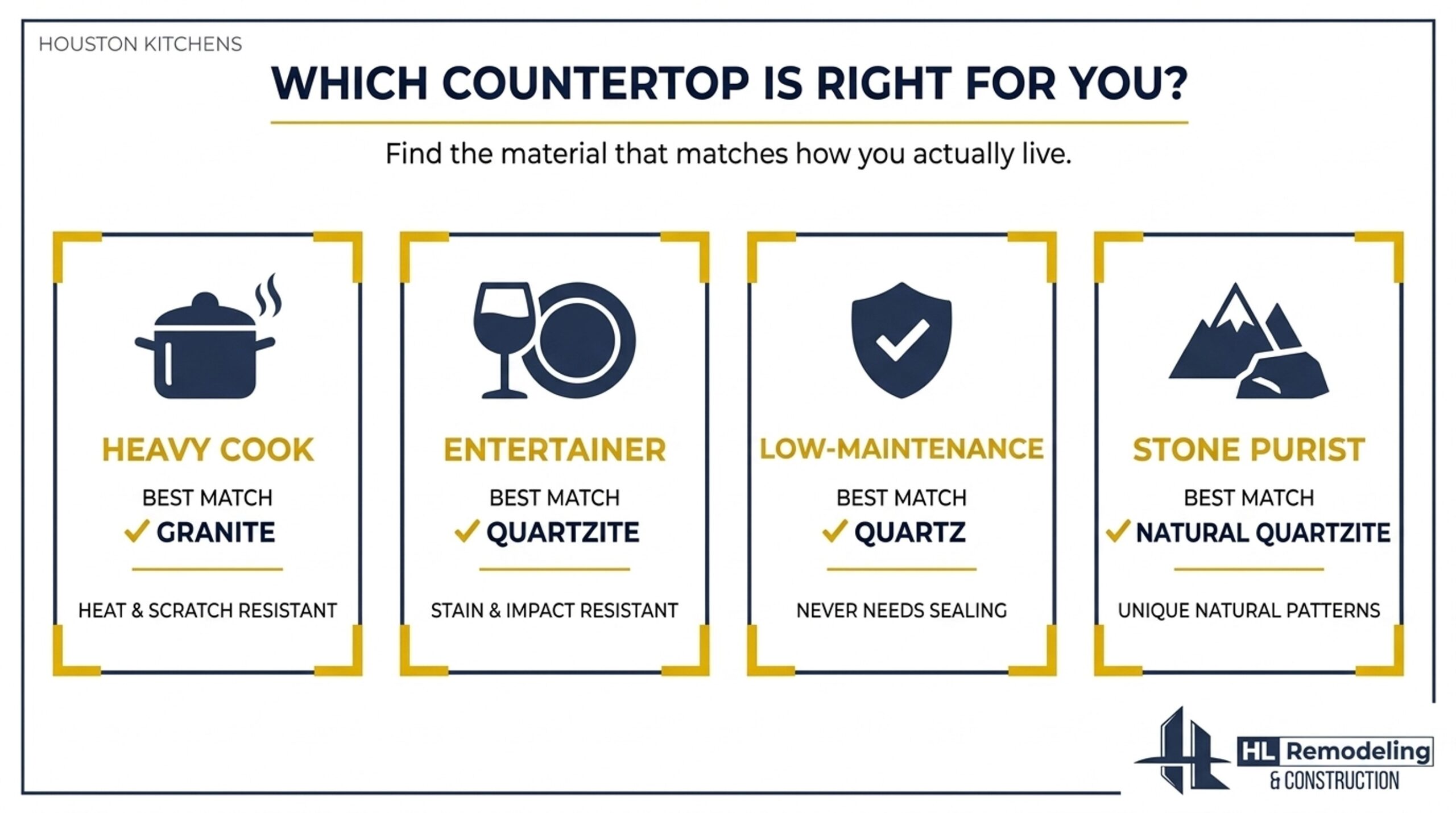
Which One Should You Pick? A Checklist by Buyer Type
Match the stone to how you cook and entertain, not to a showroom photo. A heavy cook and a weekend entertainer should not necessarily choose the same surface. Here is where we land for each buyer:
- Heavy cook: granite or quartzite, because both take heat and need only periodic sealing as maintenance.
- Entertainer: a book-matched quartzite island, since it photographs well and handles spills when sealed.
- Low-maintenance seeker: quartz, because it never needs sealing, offers low upkeep, and cleans with soap and water.
- Natural-stone purist: quartzite or an exotic granite, accepting an annual sealing routine.
- Busy family: quartz, which wins on stain resistance and speed of cleanup.
When a Mixed-Material Kitchen Makes Sense
Many kitchens pair quartz on the perimeter with quartzite on the island. That controls cost while keeping a statement piece. A pro should confirm slab thickness and seam placement so the two surfaces meet cleanly. If you want fast cleanup where you work and drama where you entertain, this split is hard to beat.
How Long Does It Take to Fabricate and Install Countertops in Houston After a Template?
Most Houston countertops are fabricated and installed one to three weeks after template. Hurricane season and complex waterfall work stretch that. Fabricator norms put install day at a few hours and cure at 24 to 48 hours. The sequence matters: cabinets are set first, then template, fabrication, and install, followed by plumbing hookups and backsplash.
Changing slabs after template costs time, which is why we lock the slab number early. Plumbing and electrical changes in a full remodel can trigger permits through the Houston Permitting Center, while a straight countertop swap is typically exempt as finish work.
How Selection Days Keep the Schedule Intact
Our Fast-Track Selection Days put cabinetry, countertops, tile, and fixtures into one guided showroom visit. That cuts out the weeks of back-and-forth that usually delay a kitchen remodel. You also get pre-trade arrival notices, so you know when the templater and installer show up, and the owner stays on the phone with you throughout. Every cost is written down before it is spent, so a slab upgrade never shows up as a surprise on an invoice.
What Happens Between Template and Install
While your slab is cut, polished, and edged off-site, we coordinate the plumber for sink and faucet reconnects. We also schedule the backsplash and flooring touch-ups so nothing waits on another trade. You see the plan in writing before it happens.
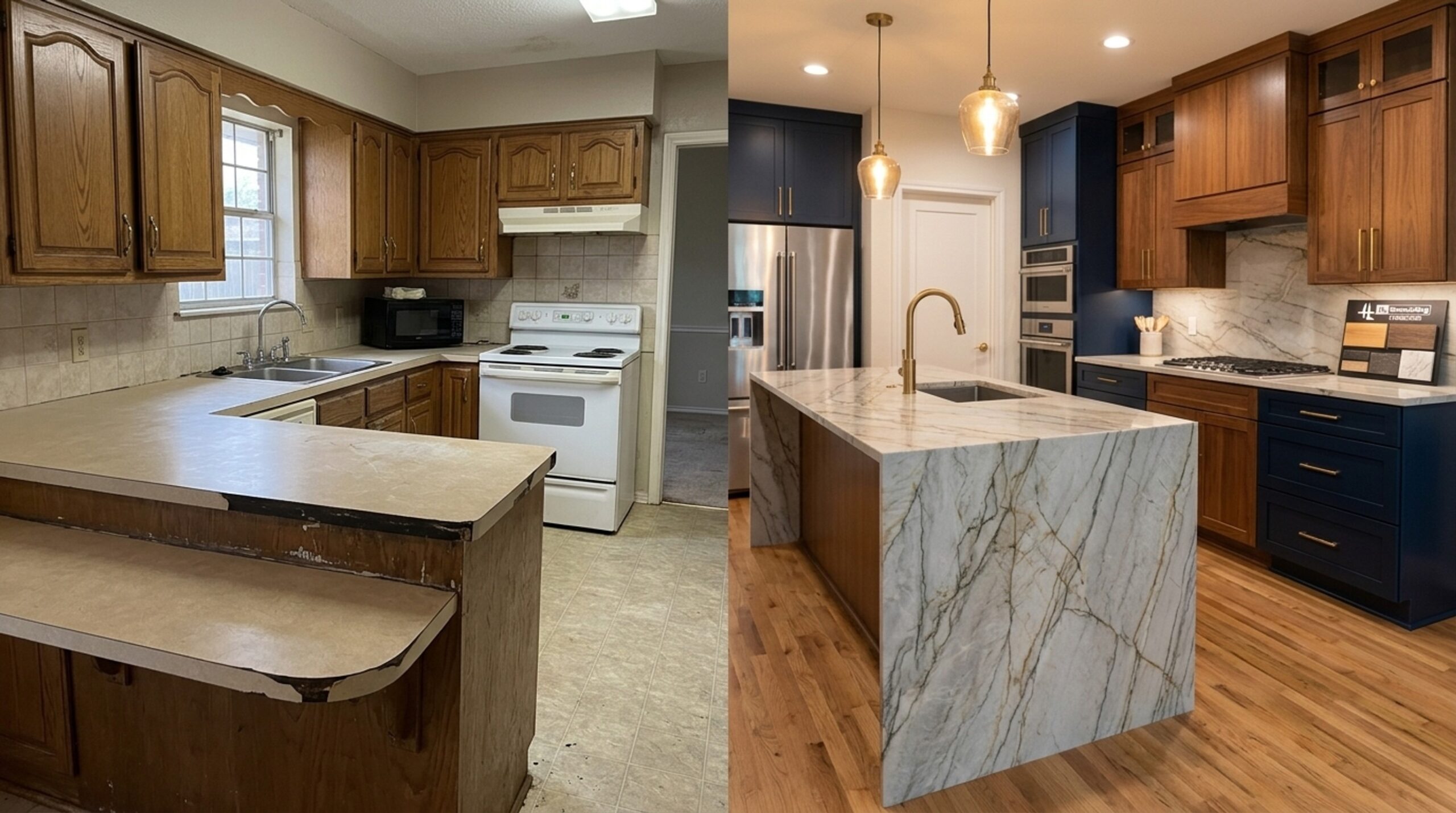
What Should You Decide Before You Call a Remodeler?
Pick the material that fits how you cook, verify the slab in person, and set the countertop decision early in the sequence. Natural-stone buyers lean toward quartzite or premium granite, and low-maintenance buyers lean toward quartz. If you are weighing slab, layout, and budget together for your Houston kitchen, we invite you to Get a Free Consultation with HL Remodeling at (346) 837-0007. We will talk through your slab choice, layout, and budget before any cabinet order locks in.
FAQ
Which is better for a Houston kitchen remodel: quartz, granite, or quartzite?
Quartzite or premium granite is better for buyers who want natural stone, heat resistance, and value, while quartz is better for low maintenance. Quartz avoids sealing, but granite and quartzite handle heat and sun more reliably. HL Remodeling can match the slab to your cooking habits and layout.
Is quartzite better than granite or quartz for kitchen countertops?
Quartzite is generally harder and more heat tolerant than granite and quartz, with veining that rivals marble. It also costs more and needs sealing, and some stones sold as quartzite are actually softer. Verify the slab with an acid and scratch test before you buy.
How much do quartz, granite, and quartzite countertops cost per square foot installed in Houston?
Houston installed prices run about $50 to $150 for quartz, $40 to $140 for granite, and $75 to $210 for quartzite per square foot. Published sources disagree, so treat these as planning ranges. Slab grade, edge profile, waterfall legs, and cutouts shift the final number.
Does quartz countertop fade or discolor in sunlight or heat?
Quartz can yellow under sustained direct UV and can scorch from hot pans. Indoor sun behind glass rarely causes damage, according to Caesarstone, but outdoor installs are excluded from most warranties. Use trivets near the range and choose granite or quartzite for sun-heavy or outdoor-adjacent spaces.
Which countertop material adds the most resale value to a Houston home?
No single material wins, but natural-stone statement slabs tend to read as the most premium in Houston’s high-end neighborhoods. Quartz protects value through consistency and low wear. Condition, neutral color, and overall kitchen quality matter more than the category alone.
Do granite and quartzite countertops need to be sealed, and how often?
Granite and quartzite both need sealing, typically every one to three years. Houston humidity favors annual checks. Drop a tablespoon of water on the surface, wait 30 minutes, and reseal if it darkens the stone.
How long does it take to fabricate and install countertops in Houston after a template?
Fabrication and install usually take one to three weeks after template. Complex waterfalls and hurricane-season backlogs can add time. Locking your slab before cabinets finish keeps the schedule from stalling.