
Use 1 CFM for every 100 BTU of gas burner output. That’s the starting point. For electric and induction ranges, multiply your kitchen’s square footage by ceiling height and your desired air changes per hour instead. Then check that number against duct length, hood width, and Houston’s 400 CFM make-up air rule before you finalize your layout.
If you’re mid-remodel with a big island and a professional-style range in your plans, this is the number you need before anything else moves forward. Get it wrong, and you won’t find out until after the cabinets are ordered and the electrical work is scheduled. That’s the most expensive time to catch a mistake. Kitchen ventilation isn’t a detail you bolt on at the end, it’s a calculation that shapes duct routing, cabinet layout, and electrical rough-in all at once. We tell Houston homeowners to lock in these specs before finalizing their kitchen remodeling plans, not after. Installation should follow the numbers, not the other way around.
Key Takeaways
- Gas ranges need roughly 1 CFM per 100 BTU of total burner output. So a 65,000 BTU range needs at least 650 CFM before duct losses.
- Electric and induction ranges are sized differently. This method uses kitchen square footage, ceiling height, and a target air changes per hour rate.
- Once a range hood exceeds 400 CFM, Houston’s building code requires a make-up air system. This offsets the negative pressure the hood creates.
- Every foot of duct and every 90-degree elbow lowers your hood’s real-world airflow below its rated CFM, sometimes by a lot.
- A hood should match or beat your cooktop’s width. Island hoods should run a few inches wider to make up for open sides.
What Is the Formula to Calculate Range Hood CFM?
CFM stands for cubic feet per minute. It measures how much air a range hood pulls through its filter and out of your kitchen every sixty seconds. Getting this number right is the whole point of sizing a hood. Too low, and smoke and fumes linger. Too high, and you pay for airflow you don’t need while dealing with extra noise.
The BTU-to-CFM Method for Gas Ranges
For gas ranges, the standard rule is 1 CFM for every 100 BTU of combined burner output. Add up the BTUs from every burner on your cooktop. Divide by 100, and that’s your baseline CFM before any deductions for duct length. A range with four burners at 15,000 BTU each, plus one 20,000 BTU power burner, totals 80,000 BTUs. That puts you at 800 CFM minimum.
The Square-Footage and ACH Method for Electric and Induction Ranges
Electric and induction cooktops don’t make an open flame, so BTU output isn’t what matters here. Instead, multiply kitchen square footage by ceiling height. Multiply that by your target air changes per hour, then divide by 60 to get CFM. Most kitchens aim for 15 ACH. Open-concept spaces often need more.
Worked Example: Sizing a Hood for a Houston Open-Concept Island Kitchen
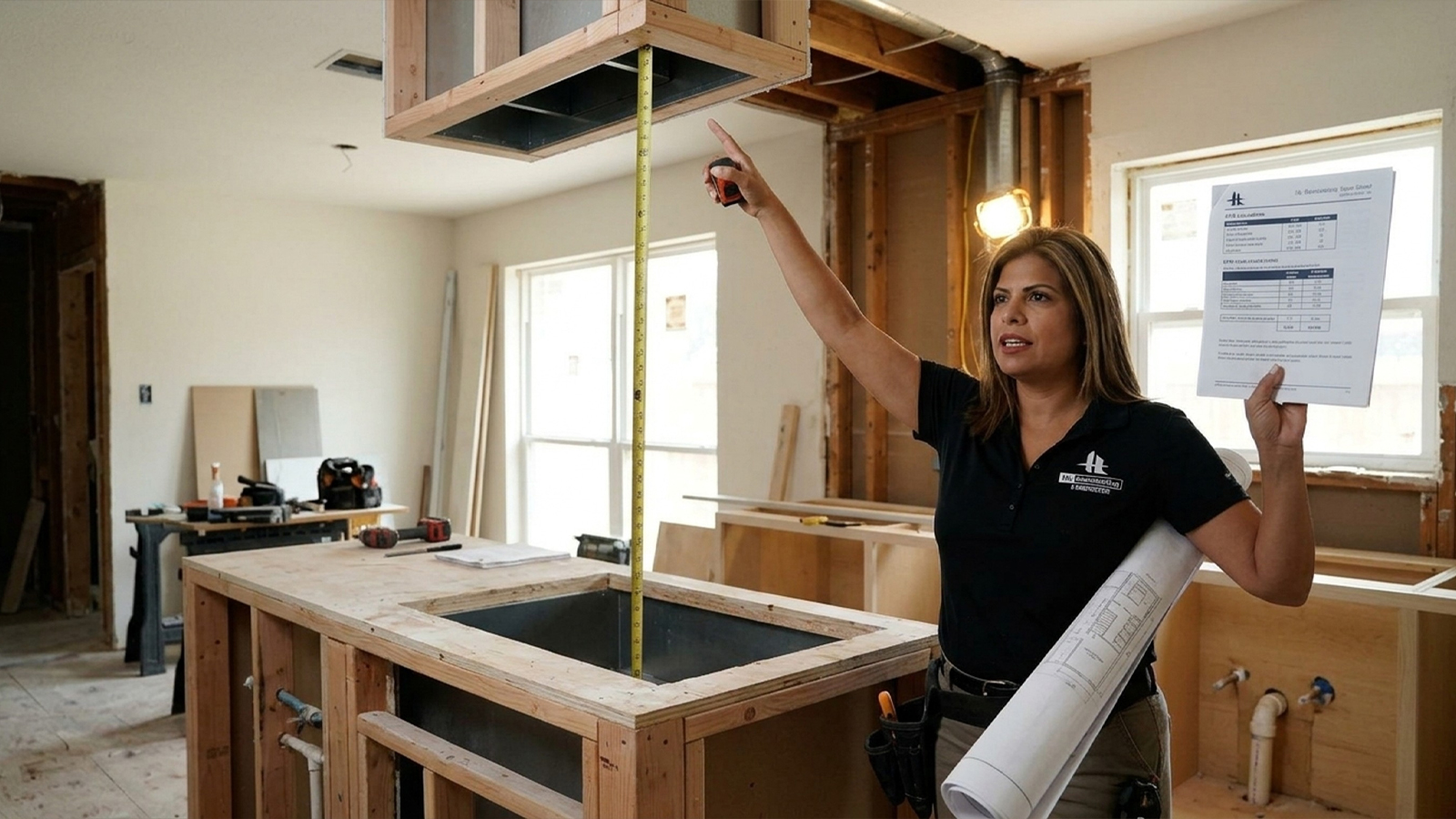
Picture a common Houston layout: a 300-square-foot open-concept kitchen with 10-foot ceilings, a large island, and a 36-inch professional-style gas range rated at 75,000 total BTUs. The BTU method puts you at 750 CFM. Swap in an electric cooktop for that same kitchen, and the ACH method (300 x 10 x 15 / 60) lands near 750 CFM too, once you account for the open floor plan pushing ACH toward the higher end. Either way, you’re shopping in the 700-800 CFM range before duct losses. Not the 300 CFM your builder-grade under-cabinet hood was rated for. Running the numbers for both fuel types side by side, alongside your broader plans for kitchen layouts, is often the fastest way to choose the right formula for your specific kitchen.
If your remodel plans are still on paper, this is a good moment to double-check your math with someone who does it daily. A quick conversation before cabinet orders go in can save you from a hood that arrives too small for the range you already bought.
Why Houston Kitchens Need Special Ventilation Consideration
A ventilation system that works fine in a dry climate can fall short in Houston. Bush Intercontinental Airport logs average annual humidity in the 75-80% range, and that extra moisture changes how grease behaves in your kitchen.
Humidity, Grease Buildup, and Indoor Air Quality
Grease particles stick to moisture in the air. In a humid climate, they settle onto cabinetry, backsplashes, and countertops faster than they would somewhere drier. Undersized ventilation lets that film build up, which shortens the life of lower-grade cabinet boxes and hurts indoor air quality over time.
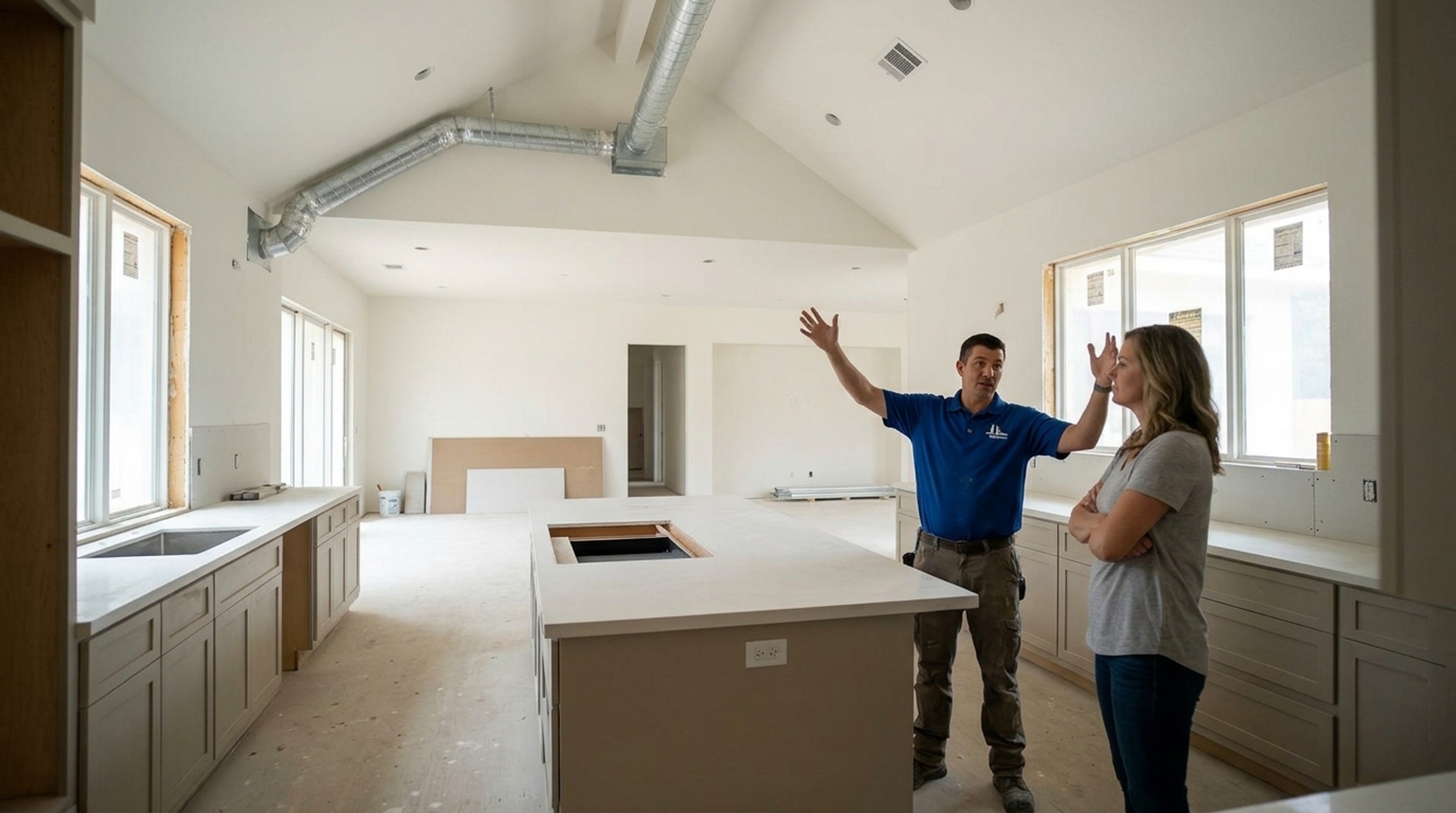
Open-concept kitchens make this worse. Cooking odors and frying fumes drift straight into the living and dining space with no door or wall to slow them down. That’s one reason we push Houston clients toward a slightly higher CFM range hood than a national calculator might suggest for the same square footage. Anyone who likes to fry at high heat will notice the difference fastest, since that kind of cooking throws off far more airborne grease and fume buildup than a simmering pot ever will.
Do I Need a Make-Up Air System for a Range Hood in Houston?
Yes. Once a range hood exceeds 400 CFM, Houston’s mechanical code requires a make-up air system to replace the air being pulled out. Texas has no single statewide residential code, but Houston and nearby areas build their permitting rules around the International Residential Code and International Mechanical Code. Both trigger this rule at that same threshold. Any renovation or upgrade that pushes a hood into that territory needs to account for it early.
Pulling that much air out of a house creates negative pressure. This can pull unwanted air in through gaps in the walls, or worse, cause a gas water heater or furnace to backdraft. Any kitchen remodel that touches gas lines, electrical circuits, or wall removal needs a permit through the City of Houston Development Services Department, since local building codes treat ventilation as a life-safety issue, not just a comfort one. This isn’t a detail worth guessing on, and it’s exactly the kind of code question we walk clients through before permits get filed.
Duct Sizing: What Size Duct Is Needed for a 600 CFM Range Hood?
A hood’s CFM rating is measured under ideal conditions: a short, straight duct run. Real installations rarely look like that. Every foot of ducting and every elbow lowers airflow. So a 600 CFM hood with a long or bent duct run might only deliver 450 CFM by the time air reaches the outside vent. That’s why getting duct size right matters as much as picking the hood itself.
How Duct Length and Bends Reduce Effective Airflow
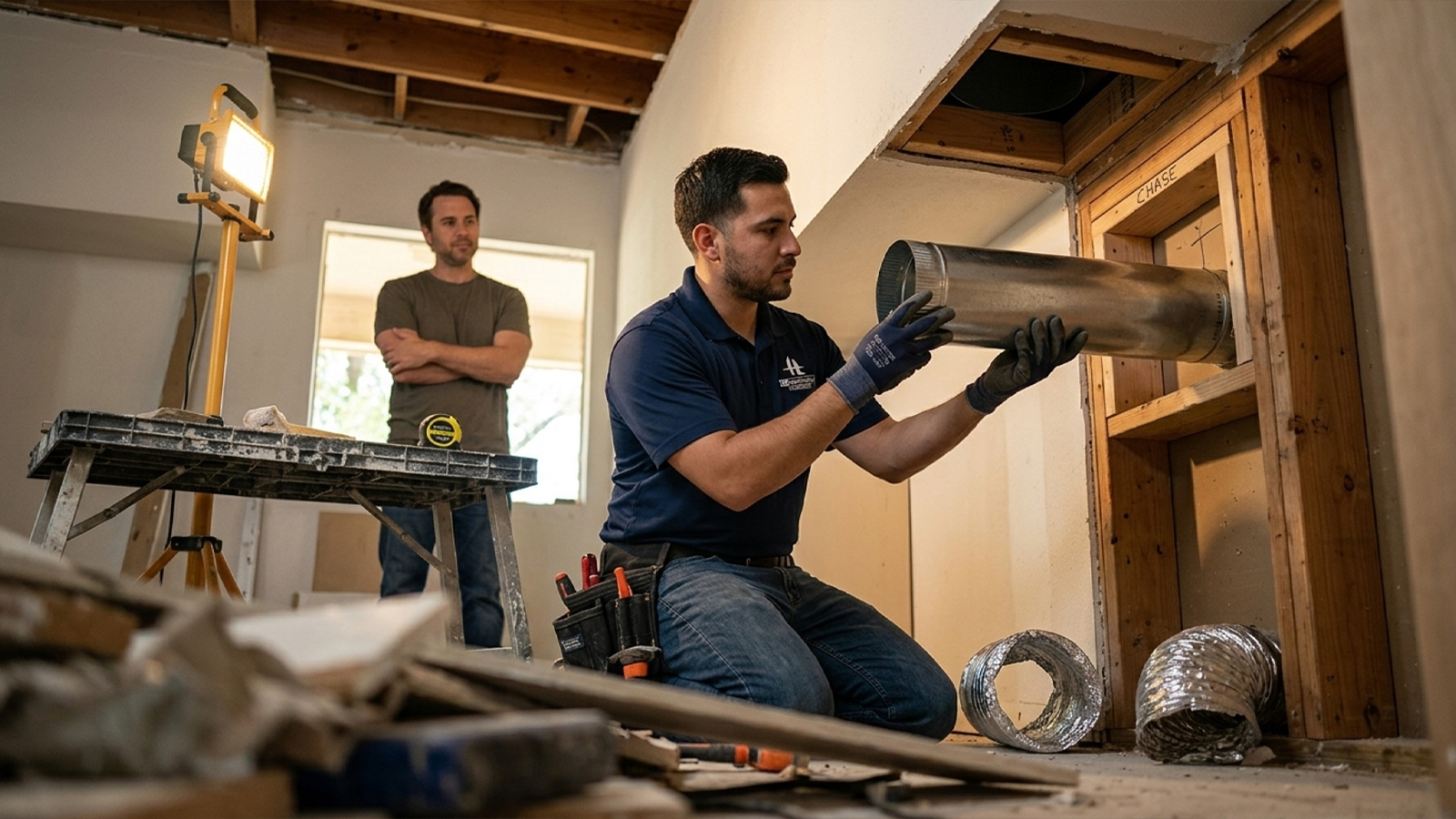
A common rule of thumb treats every foot of straight duct as costing roughly 1 CFM of airflow. Each 90-degree elbow counts as if it added several extra feet of straight duct. Houston remodels often route island hood ductwork through attic space before it reaches an exterior wall or roof cap, and that longer path adds up fast. If your plan includes two or three elbows to clear framing, you may need to size your hood 100-150 CFM higher than your formula suggests, just to get the airflow you actually need.
Duct Diameter Chart by CFM Rating
| Duct Diameter | Max Effective CFM (straight run) | Typical Use Case |
|---|---|---|
| 6-inch | Up to 300 CFM | Standard residential range, under-cabinet hood |
| 8-inch | 400-600 CFM | Mid-to-high CFM wall or island hood |
| 10-inch | 900+ CFM | High-output professional range, long or bent runs |
An undersized duct chokes airflow no matter how strong the blower is. A hood rated for 800 CFM pushed through 6-inch ducting will perform badly. Recirculating hoods skip ductwork altogether. They recirculate air through a charcoal filter and send it back into the room instead of venting it outside. This filters grease but does little for heat, humidity, or cooking odors, which makes it a weaker choice for Houston’s climate.
Range Hood Size, Type, and Mounting Height
Choosing the right range hood means matching type, width, and mounting height to your specific cooktop and kitchen layout. Don’t just pick whatever CFM number the formula gives you. Choosing the right hood for your specific range is what separates a kitchen that stays clear during a hard sear or a big batch of fried food from one that fills with smoke every time.
Wall-Mount vs. Island vs. Downdraft vs. Under-Cabinet Hoods
Wall-mounted hoods sit against a rear wall and work well in traditional layouts. Island hoods hang from the ceiling above a cooktop with no wall behind it, which is increasingly what Houston remodelers see requested in open-concept kitchens. Downdraft units rise from behind the cooktop and pull air downward, a compromise choice that trades some capture area for a cleaner look. Under-cabinet hoods mount beneath upper cabinets and work well in smaller kitchens with standard-output ranges, rather than high-output professional models.
Matching Hood Width and Mounting Height to Your Cooktop
Getting the width and height right determines whether your hood actually captures what it’s rated to move.
- A wall-mounted hood should be sized equal to or wider than the cooktop, to keep full capture area across all burners.
- An island hood usually needs to run 3-6 inches wider than the cooktop, since there are no side walls to help contain smoke and steam.
- Mounting height generally falls between 30 and 36 inches above the cooking surface. Higher-CFM hoods are often mounted toward the taller end of that range.
- Ducted hoods vent grease, heat, and odor outside the home. Ductless (recirculating) hoods filter air and send it back into the room, a tradeoff worth thinking through carefully in a humid climate.
Mount a hood too low, and you crowd the cook. Mount it too high, and smoke escapes into the room before the hood can catch it.
Sones, Noise, and Dual-Blower Options for Quiet, High-CFM Performance
Noise is measured in sones. A high-CFM hood run at full speed can get loud enough that homeowners stop using it, which defeats the whole purpose. Brands like Wolf, Viking, Zephyr, and Broan address this with dual-blower or remote-blower designs. These move the loudest part to the attic or exterior wall, so the noise stays out of the kitchen. If you’re set on a high-output range, ask specifically about sones at your target CFM setting. Not just the top-speed number on the box. Look for HVI-certified airflow and sone ratings when comparing models, since that certification means the numbers on the spec sheet were tested to a real standard instead of estimated by the manufacturer.
Conclusion: Plan Your Range Hood Before You Finalize Your Remodel
Sizing a range hood comes down to a sequence: calculate CFM from your range’s BTU output or your kitchen’s square footage, check that number against Houston’s 400 CFM make-up air rule, size the duct to match, then confirm hood width and mounting height against your actual cooktop. Skip a step, and you risk a hood that’s too loud to run, too weak to clear smoke, or too big for the ductwork your framing allows.
You now have the language for it: your CFM number, your duct size, and the point where make-up air becomes mandatory. That’s exactly the kind of detail that needs to be settled before cabinetry and electrical plans get finalized, alongside every other decision in your kitchen remodel, not separately from it. If you’d rather talk it through than run the numbers alone, we’re happy to walk through your range, your layout, and your duct run together before anything gets ordered. You can reach us at (346) 837-0007, or get a free consultation and we’ll take it from there.
FAQ
What size range hood do I need for a 36-inch range?
A 36-inch range needs a hood that is at least 36 inches wide, and wider still if it’s mounted over an island. Stove width and hood width should match at minimum to keep full capture area across every burner. On an island with no side walls, sizing the hood 3 to 6 inches wider helps contain smoke that would otherwise drift past the edges. Final width should still be checked against your duct routing and cabinet clearance before you order.
How many CFM does a range hood need for gas stoves?
Gas stoves need roughly 1 CFM for every 100 BTU of combined burner output. A range totaling 75,000 BTUs across all burners needs a hood rated near 750 CFM before duct losses are factored in. Real-world performance depends on duct length and bends, so many homeowners size slightly above this baseline. A contractor can confirm the exact number once your duct run and hood model are known.
What is the formula to calculate range hood CFM?
The formula depends on fuel type: gas ranges use 1 CFM per 100 BTU of burner output, while electric and induction ranges use kitchen square footage multiplied by ceiling height and desired air changes per hour, divided by 60. Most sizing mistakes happen when homeowners stop at this step and skip the duct deductions entirely. Combining both the base formula and the duct-length math is what actually predicts real-world performance.
Do I need a make-up air system for a range hood in Houston?
Yes. Once your range hood exceeds 400 CFM, Houston’s mechanical code requires a make-up air system. This rule exists because pulling that much air out of a house creates negative pressure, which can backdraft gas appliances or pull in unwanted air from outside. Any kitchen remodel with a high-CFM hood should include this in the permit application from the start. A licensed remodeler can confirm sizing and placement as part of the mechanical plan.
How far should a range hood be from the cooktop?
A range hood should typically mount between 30 and 36 inches above the cooking surface. Higher-CFM hoods often sit toward the taller end of that range to balance capture area against comfort for the cook. The exact number shifts based on the hood model and manufacturer specs, so this should be confirmed before cabinetry is installed. Mounting too high lets smoke escape before the hood pulls it in, while mounting too low crowds the workspace.
What size duct is needed for a 600 CFM range hood?
A 600 CFM range hood generally needs at least an 8-inch duct to move that much air without choking airflow. A 6-inch duct caps out well below that, typically around 300 CFM on a straight run, which would badly underperform a 600 CFM-rated hood. Long runs or multiple elbows may call for sizing up further, especially on installations routed through attic space. Duct routing should be finalized before framing and electrical work locks in the path.
Why does my kitchen stay smoky with the vent on?
A smoky kitchen with the range hood running usually points to undersized CFM, a hood narrower than the cooktop, or ductwork that’s choking real airflow below the rated spec. One homeowner we worked with had a builder-grade hood rated at 300 CFM sitting over a new 48-inch professional range, a mismatch no amount of fan speed could fix. Once we sized a proper 700 CFM hood with correct duct diameter, the smoke and lingering odor problem disappeared. If your current setup is struggling, it’s worth having the whole ventilation system checked rather than just swapping the hood.