
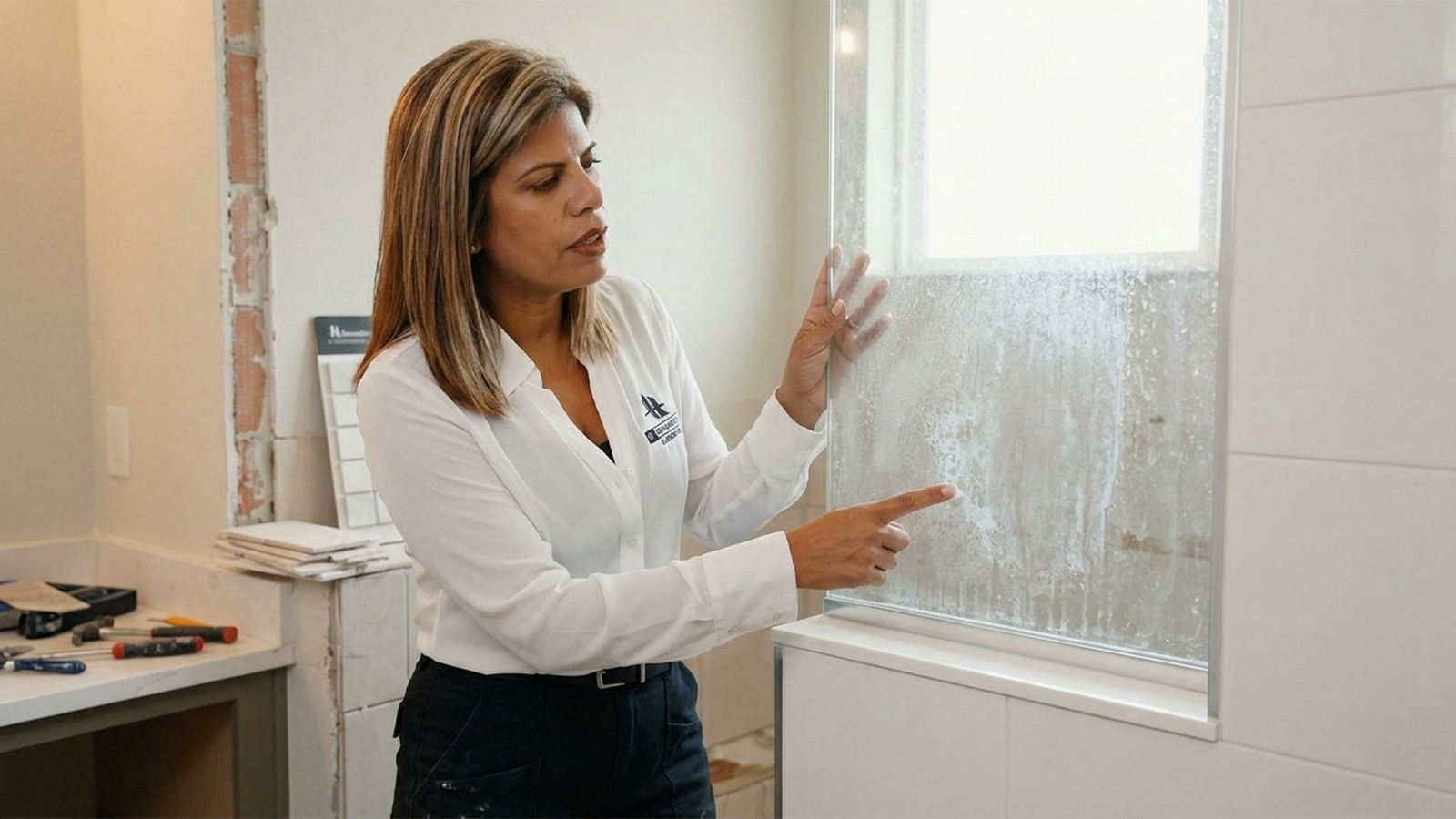
You’ve scrubbed that shower glass every weekend for months. It still looks cloudy by Wednesday. That’s not a cleaning failure. Houston’s hard water is actually changing the surface of your glass, fixtures, and grout. No amount of elbow grease can fix that on its own. The good news is this problem has a real, lasting fix. It usually starts with a bathroom remodel that plans for water chemistry from the first design decision.
Key Takeaways
- Houston’s city water averages around 135.5 ppm (about 8 grains per gallon). Some areas test as high as 229 ppm (roughly 13 GPG), based on Houston Public Works water quality reporting [1].
- Hard water causes three separate problems in a bathroom: permanent glass etching, fixture corrosion, and mineral crust buildup in grout and tile.
- Vinegar and CLR remove surface stains. But they cannot undo true etching. Etching is a permanent change to the glass itself.
- A water softener that meets the ANSI/NSF 44 standard stops new damage from forming. It works best when paired with materials like porcelain tile, epoxy grout, and corrosion-resistant fixture finishes.
- Knowing the difference between staining and etching helps you decide what to keep and what to replace during a remodel.
Is Houston’s Water Considered Hard Water? Houston’s Water Hardness Explained
Yes. On the Water Quality Association’s hardness scale, Houston’s water falls in the hard to very hard range. The city’s own numbers back this up. Houston Public Works’ most recent drinking water quality report shows the Main System’s average total hardness at around 135.5 ppm. That equals roughly 8 grains per gallon. Some readings climb as high as 229 ppm, or about 13 GPG [1].
That hardness comes from geology, not pollution. Houston gets its water from a mix of surface water, including Lake Houston and the Trinity River, and groundwater pumped from wells across the region. As that water moves through Gulf Coast soil and limestone-heavy ground, it picks up calcium and magnesium. These two minerals cause hard water in the first place. The more time water spends touching those deposits, the higher the hardness reading climbs.
What “Grains Per Gallon” Actually Measures
Grains per gallon counts how much dissolved calcium and magnesium sits in your water. Under the WQA scale, anything above 7 GPG counts as hard. Anything above 10.5 GPG counts as very hard. Houston’s average puts most homes squarely in hard territory. Many homes land in the very hard range, depending on where they sit in the system.
Why Hardness Varies Across Houston Neighborhoods
Not every Houston home has the same water quality. Homes on city water usually see the citywide averages. But homes on private wells, common in parts of Katy, Cypress, and outer Harris County, often test higher. That’s because well water spends more time touching mineral-rich soil.
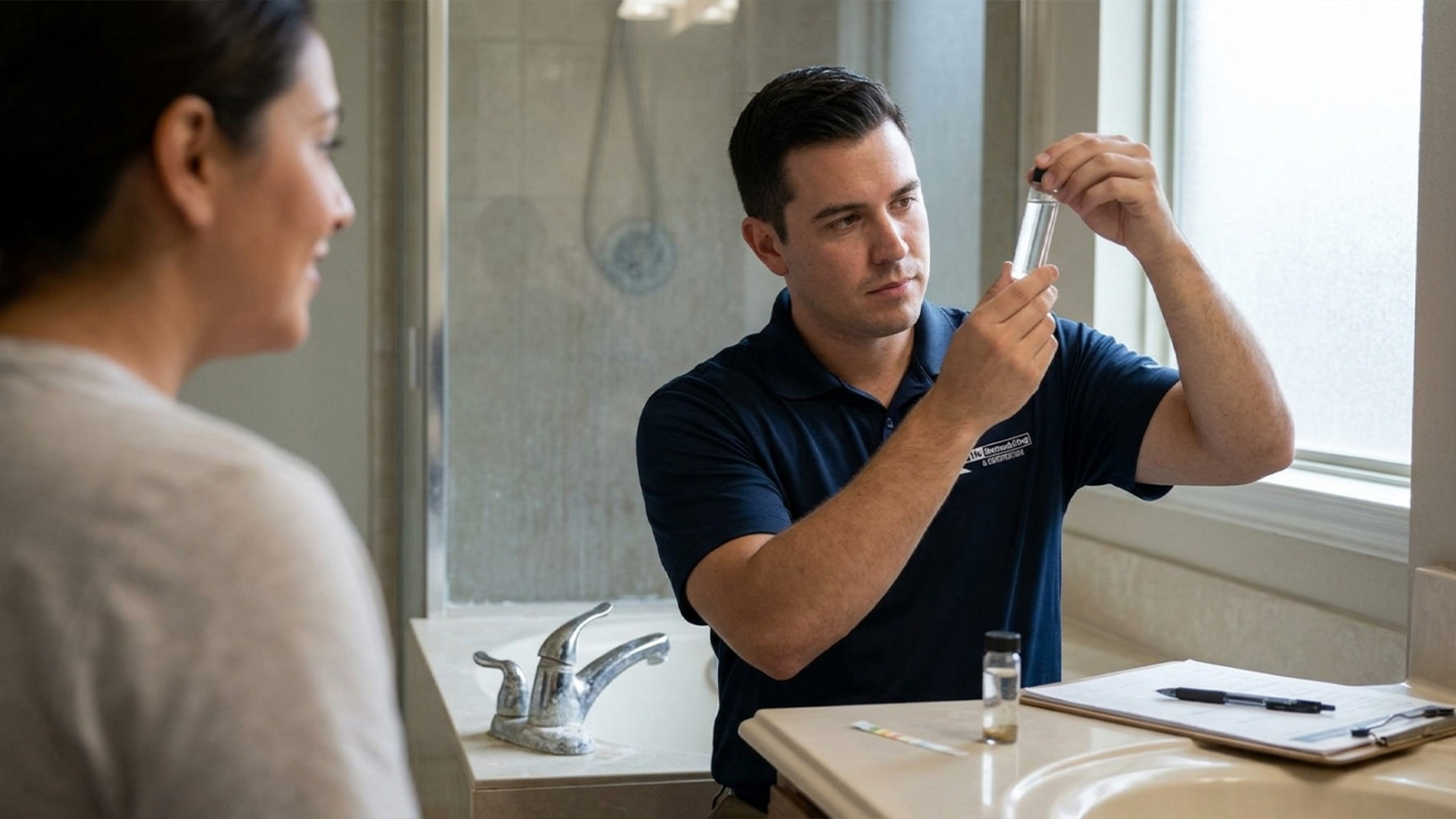
If you want your exact number instead of a citywide estimate, get a water test from a licensed plumber or water treatment company. It will tell you exactly what you’re dealing with. It’s a quick way to confirm what your bathroom has probably been telling you for years.
The 3 Ways Hard Water Damages a Bathroom
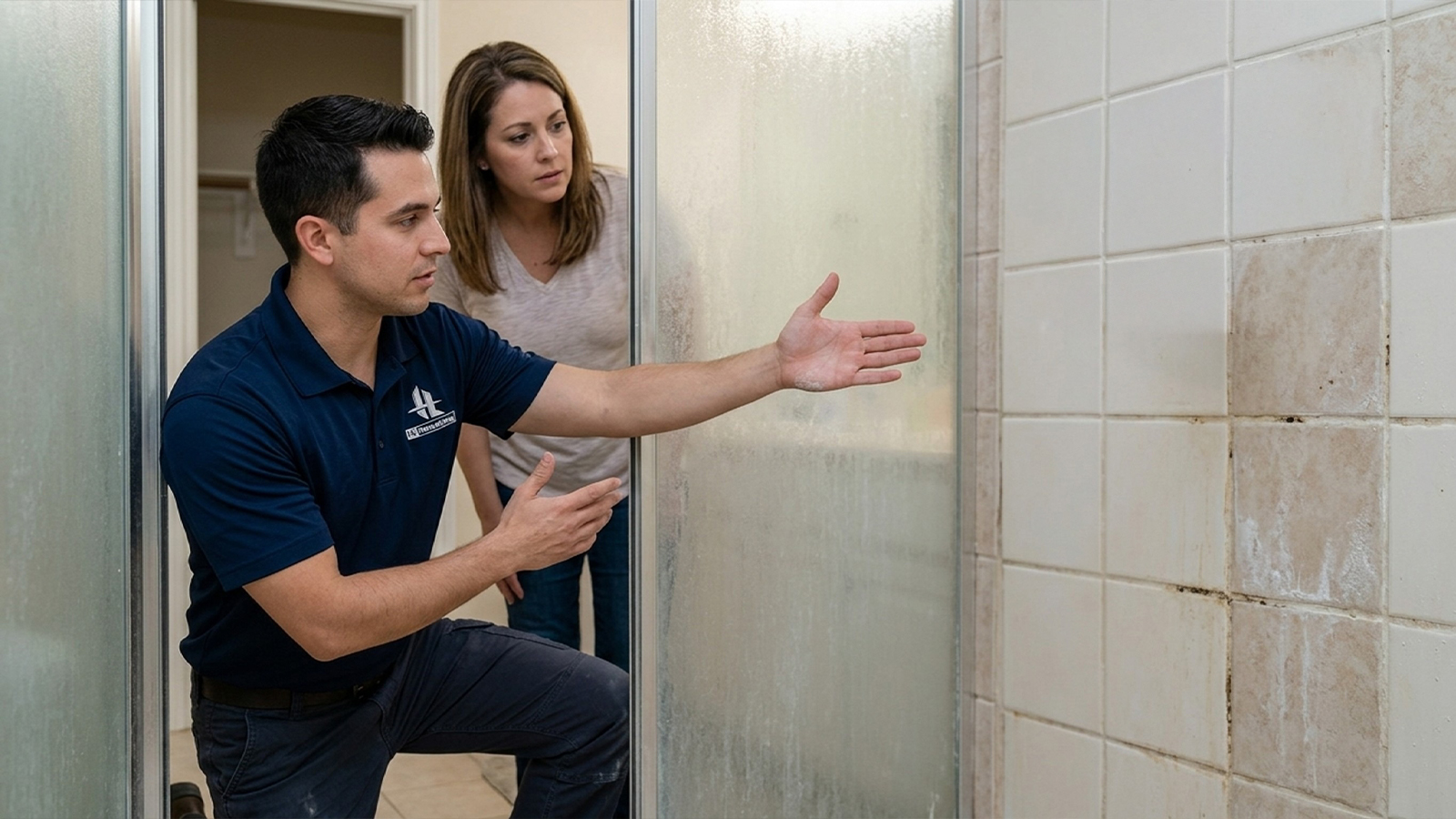
Hard water attacks a bathroom on three fronts at once. Each one looks different. Knowing which type of damage you’re seeing tells you whether cleaning will help or whether you need to replace something.
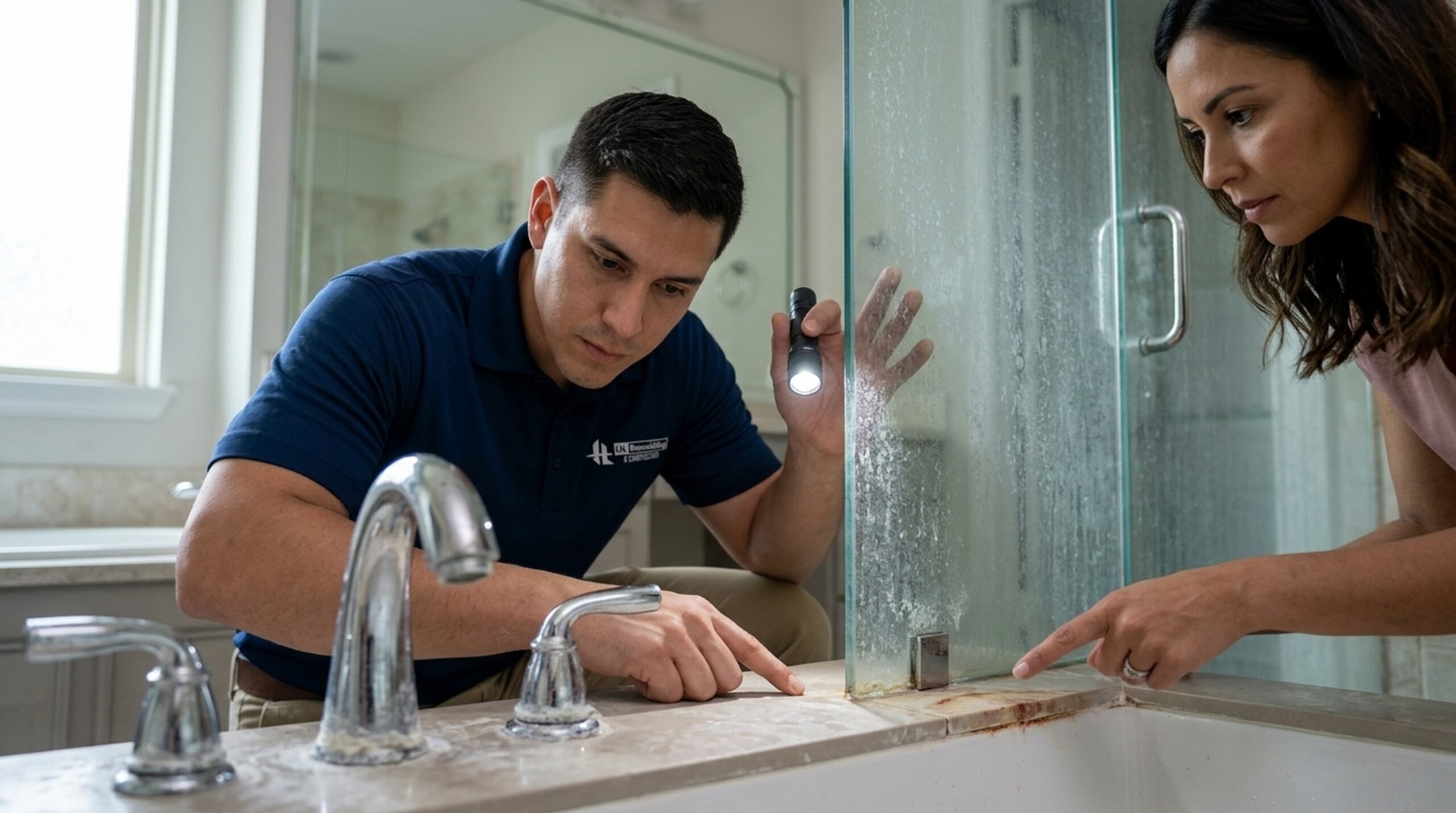
Shower Glass Etching and Permanent Haze
Staining sits on top of glass. You can wipe or dissolve it away. Etching is different. It happens when hard water dries on the glass surface and leaves calcium carbonate behind. As water evaporates, the minerals it was carrying have nowhere to go, so they settle onto the surface and slowly bond to the glass itself instead of just resting on top.
Once that bond forms, no amount of scrubbing can undo it. The surface of the glass has actually changed. Shower doors in older Houston homes, many built in the 1970s through 1990s, often show this pattern after years of daily use with no glass treatment or coating.
Fixture Corrosion: Chrome vs. Brushed Nickel
Mineral deposits build up inside faucet and showerhead openings. This blocks water flow and leaves a rough, crusted texture around aerators. Chrome finishes tend to pit and dull faster under constant hard water than brushed nickel, which handles mineral contact better.
A faucet that looked bright and new five years ago can show visible corrosion and wear out early if it’s connected to untreated hard water. The same mineral buildup can travel further than the fixture itself. It coats the inside of the pipes that feed your bathroom and slowly cuts down water flow throughout the house.
Grout and Tile Discoloration and Crust Buildup
Standard cement grout is porous, so it soaks up mineral-laden water and dries into a chalky white crust. This is a form of scale buildup that regular scrubbing can’t fully remove. Unsealed natural stone tile is at even greater risk. It can both stain and etch under the same conditions that damage glass.
If any of this sounds familiar, you’re not imagining it. You’re not doing something wrong, either. This is simply what Houston’s water does to untreated surfaces over time.
DIY vs. Permanent Fixes: Stop Hard Water Before It Wins
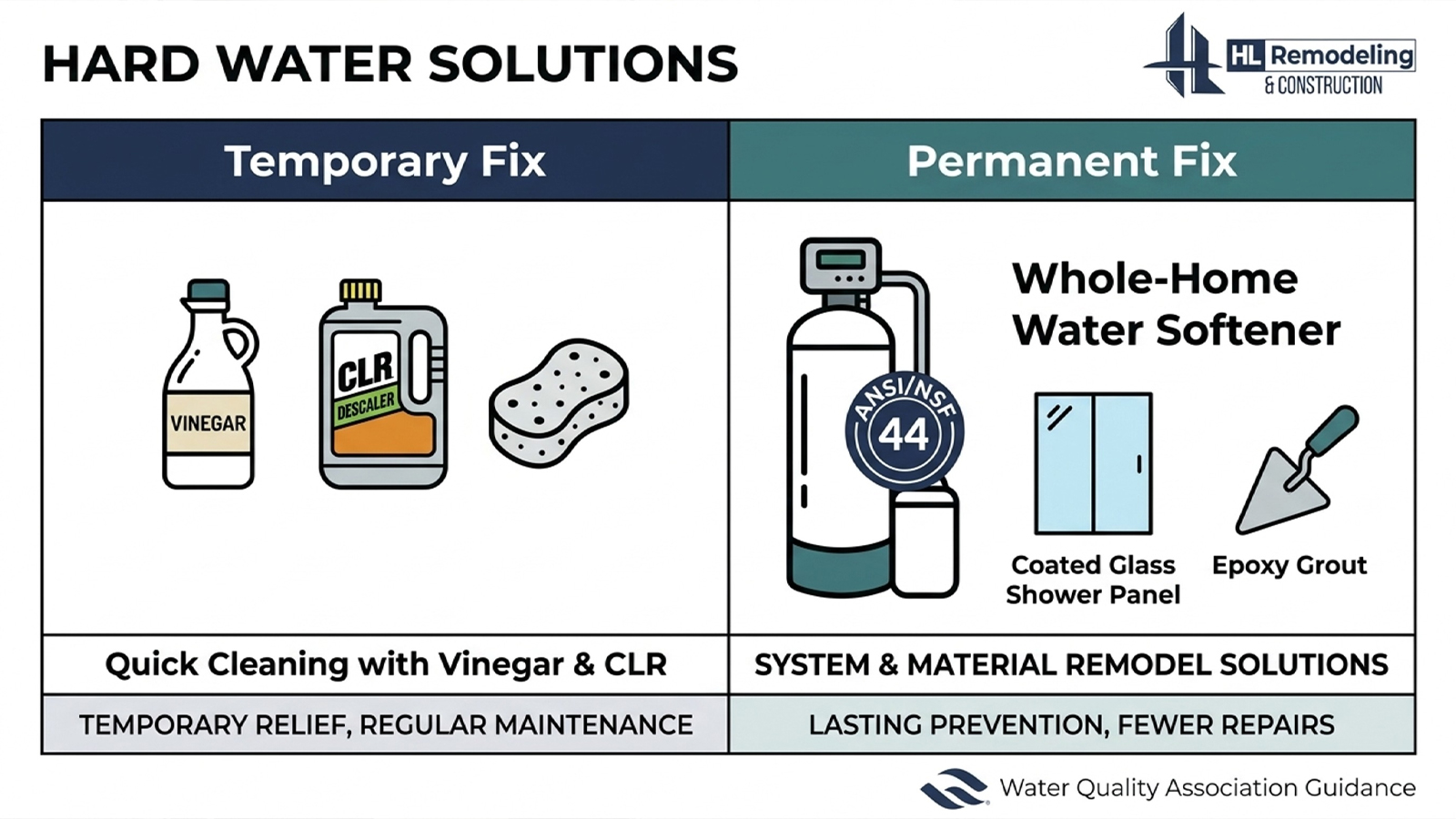
Temporary Relief: Vinegar and CLR Descaling
Vinegar and CLR descaling solutions really do work, but only on surface-level mineral deposits. They dissolve buildup already on glass, fixtures, and grout. That’s why a fresh scrub always looks better for a few days.
The problem is they do nothing to stop new mineral deposits from forming. So the cycle starts again as soon as the water runs.
Remodel-Grade Fixes That Solve the Root Cause
Installing a water softener treats the water itself before it ever reaches your glass, fixtures, or grout. This is the only way to fight hard water at the source instead of chasing it room by room. A softener uses an ion exchange system to swap calcium and magnesium for sodium.
Systems certified to the ANSI/NSF 44 standard by the Water Quality Association have been independently tested to prove they work as promised. Softening the water for your whole house, not just the bathroom, is what actually stops hard water from winning long term. A softener treats water where it enters the home, typically at the point where the main supply line is plumbed into the house. So a licensed plumber typically installs it at the main pipeline rather than at each fixture.
Many older Houston homes were built decades before softeners became common. So a bathroom remodel is often the first real chance to fix whole-house water treatment along with adding new fixtures and glass.
| Approach | What It Fixes | What It Doesn’t Fix | Typical Lifespan of Result |
|---|---|---|---|
| Vinegar/CLR descaling | Surface mineral staining | Etching, fixture corrosion, grout porosity | Days to weeks |
| Squeegee/daily wipe-down | Slows new staining | Existing etching, mineral buildup in plumbing | Ongoing maintenance |
| Water softener installation | Mineral content in all household water systems | Existing etched glass or corroded fixtures | Life of the system |
| Coated glass + sealed epoxy grout | New buildup and staining resistance | Underlying water hardness | 10+ years with a softener |
Whole-home water filtration and water filters improve taste and remove particles. But that’s a different job from softening. A softener changes hardness. Filtration improves clarity and taste. Homeowners often need both if they want lasting water treatment.
What to Choose When Remodeling in a Hard Water Environment
Once you understand these hard water problems, choosing materials gets a lot easier. Some materials just hold up better than others in hard water.
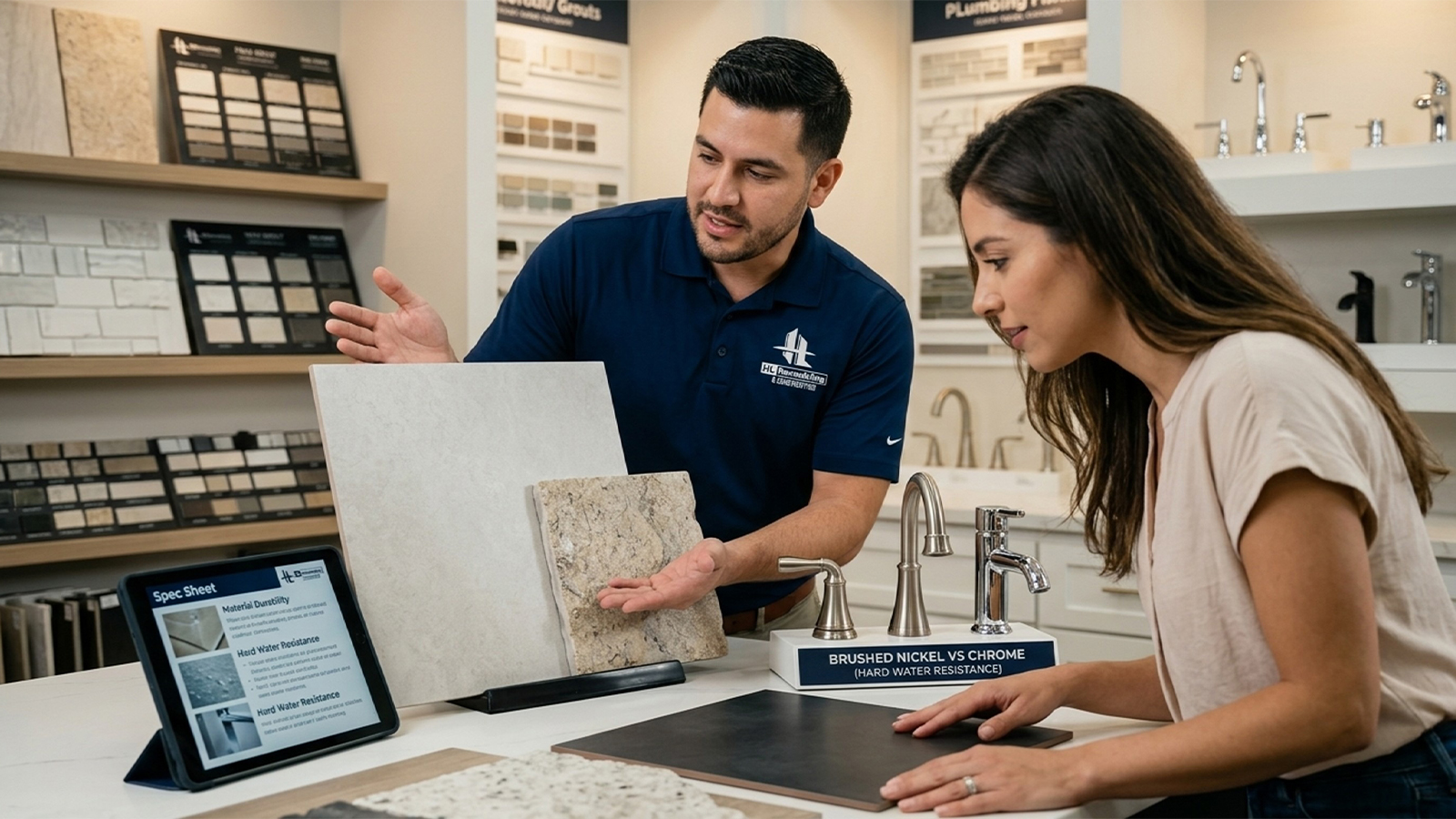
Tile and Grout: Porcelain and Epoxy Win in Hard Water
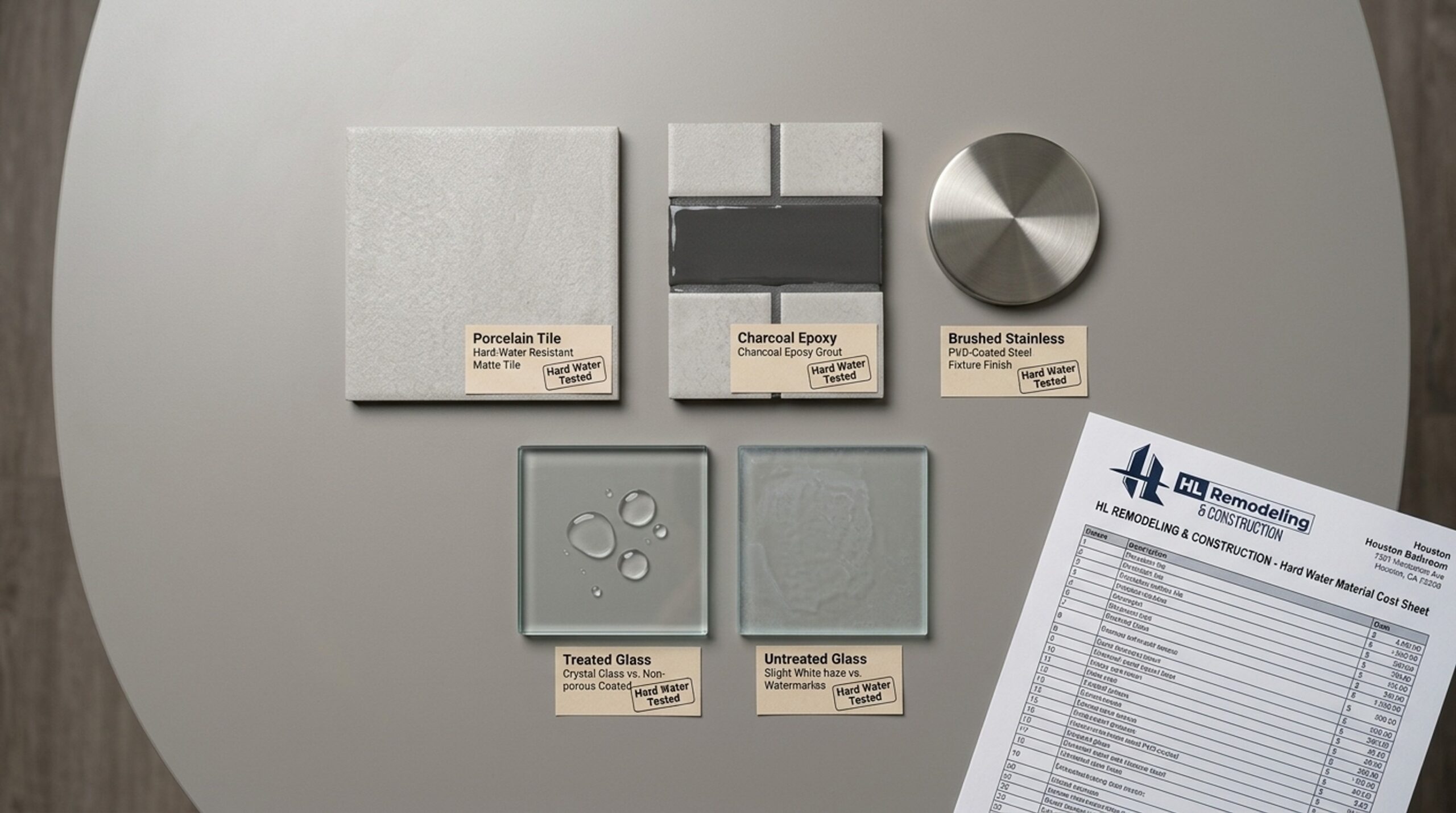
Porcelain tile is denser and less porous than standard ceramic or natural stone. So it resists mineral absorption and staining much better over time. Pair it with epoxy grout instead of cement-based grout. Epoxy is non-porous and won’t develop the white crust that plagues traditional grout lines.
Fixture Finishes That Outlast Hard Water
Brushed nickel and PVD-coated finishes resist pitting and corrosion much longer than polished chrome under constant hard water contact. If your remodel includes a new water heater, it’s worth talking about softening the water for the whole system at the same time. Mineral buildup shortens a water heater’s lifespan too. It’s often worth having a plumber check the supply lines that feed it, along with any exposed plumb fittings and connections, for early scale buildup before it turns into a bigger repair.
When you plan a bathroom remodeling process with us, we cover these decisions during our Signature Finish Showroom Experience. A dedicated selection specialist walks you through cabinetry, countertops, tile, and fixture options, with hard water resistance built into every recommendation. There’s no pressure to decide on the spot. It’s meant to help you compare options side by side before you commit to anything.
One Houston homeowner we worked with had replaced their shower glass twice in eight years before realizing the etching kept coming back. No one had treated the water. Once we paired a water softener install with coated glass and epoxy grout during their remodel, the recurring haze stopped for good.
- Choose porcelain tile over natural stone or basic ceramic for shower walls and floors.
- Ask for epoxy grout instead of standard cement-based grout when you pick your tile.
- Choose brushed nickel or PVD-coated fixtures over polished chrome for faucets, showerheads, and hardware.
- Ask about treated or coated glass options for a frameless shower enclosure.
- Talk about water softener installation timing if you’re replacing a water heater in the same renovation.
We write down every material upgrade we recommend in our itemized cost ledger. That way, choosing hard-water-resistant options never turns into a surprise cost halfway through your project.
Signs Your Bathroom Has Hard Water Damage
Not sure if what you’re looking at is hard water damage or just an old bathroom? Run through this list. If two or more of these sound like your home, hard water is likely playing a role.
- Shower glass feels rough or gritty to the touch, even right after cleaning.
- Cloudy haze on the glass returns within days of a thorough scrub.
- Faucet or showerhead finishes look dull, pitted, or discolored compared to when they were installed.
- White or chalky crust forms along grout lines, especially near the shower floor and corners.
- Water flow from the showerhead feels weaker than it used to.
- Grout that was once white or gray now looks yellowed or gray-brown no matter how often it’s cleaned.
- Natural stone tile shows dull spots or rough patches that weren’t there a few years ago.
How We Help You Choose Hard-Water-Resistant Materials Without Surprises
Picking materials that hold up to Houston’s water shouldn’t mean guessing or paying for a lesson learned the hard way. During your Signature Finish Showroom Experience, a dedicated selection specialist walks you through porcelain, epoxy grout, and fixture finish options in person. That way, you can see and touch the difference before you decide.
Every recommendation gets written into our full-transparency cost ledger. This is an itemized, written proposal that spells out what you’re paying for and why. If a material upgrade makes sense for your water conditions, you’ll see the cost in writing before it’s added to your project. No guessing, no line items that show up after the fact.
Get a Free Consultation to Address Hard Water Issues in Your Remodel
At this point, you know exactly why that glass keeps clouding up. You also know why that faucet finish keeps dulling no matter how carefully you clean it. It’s calcium carbonate and magnesium, not a mistake on your part. It responds to the right materials and water treatment, not another bottle of cleaner. That’s the kind of clarity that makes the next step easy instead of stressful.
Our owner-direct communication and full-transparency cost ledger mean you’ll always know the cost and reasoning behind every decision before work begins. This is true whether you add a water softener, upgrade to porcelain and epoxy grout, or replace etched glass. If you’re ready to talk through what fixing this looks like in your own bathroom, schedule a free consultation with us or call (346) 837-0007. No pressure, just a straight conversation about your options.
FAQ
Is Houston’s water considered hard water?
Yes, Houston’s water is classified as hard to very hard on the Water Quality Association’s hardness scale. Houston Public Works’ water quality reporting shows average hardness levels well above the 7 GPG mark that defines hard water [1]. This is why so many Houston bathrooms show glass haze, fixture wear, and grout crust well before those materials would normally show age. The fix isn’t more scrubbing. It’s choosing materials and treatment systems built for these conditions.
What is the water hardness level in Houston, TX?
Houston’s average water hardness is roughly 135.5 ppm, or about 8 grains per gallon. Some parts of the system test as high as 229 ppm, close to 13 GPG, according to Houston Public Works [1]. Your exact number depends on whether you’re on city water or a private well, since well water in outer Harris County often runs higher. A professional water test during a remodel consultation will give you your home’s exact reading instead of the citywide average.
How do you remove hard water stains from shower glass permanently?
Removable staining comes off with regular cleaning, but permanent etching does not. Telling the two apart is the first step. Vinegar or CLR descaling solutions handle surface mineral deposits and hard water spots well, often within a few minutes. If the haze stays after cleaning and feels rough instead of smooth, that’s etching. It’s a change to the glass itself that no cleaner can reverse. At that point, replacing the panel with coated or treated glass during a remodel is the only lasting fix.
Does a water softener help with shower glass etching?
A water softener prevents future etching by removing the calcium and magnesium that cause it. But it cannot repair glass that’s already etched. Softened water stops new mineral deposits from forming on any surface in the bathroom, which protects new glass, fixtures, and grout going forward. That’s why installing a water softener and replacing damaged glass often happen together during the same remodel. Treating the water alone won’t restore glass that’s already been chemically changed.
What is the best tile and grout for hard water areas?
Porcelain tile paired with epoxy grout works best in hard water areas because both materials resist mineral absorption. Porcelain is far less porous than natural stone or standard ceramic, so it won’t stain or etch as easily under repeated hard water exposure. Epoxy grout is also non-porous, which stops the white mineral crust that forms in traditional cement grout lines. A showroom walkthrough with a selection specialist helps match the right finish and sheen to your layout and budget.
Can hard water ruin bathroom fixtures over time?
Yes, hard water can corrode and pit bathroom fixtures over time, especially finishes like polished chrome. Mineral deposits build up inside faucet aerators and showerheads, cutting water flow and creating a rough, crusted texture that shortens the fixture’s usable life. Brushed nickel and PVD-coated finishes hold up much longer under the same conditions. If your current fixtures show pitting or discoloration after only a few years, that’s a strong sign to plan finish upgrades during your next remodel instead of replacing pieces one at a time.
What causes Houston’s hard water?
Houston’s hard water comes from calcium and magnesium picked up as water moves through the region’s Gulf Coast soil and limestone formations. The city’s water supply comes from a mix of surface water sources, including Lake Houston and Trinity River reservoirs, and groundwater wells. Both pick up these minerals naturally. This is a geological condition, not a treatment failure. That’s why it affects the entire region rather than a single neighborhood. It’s worth understanding this cause before you commit to specific finishes. It’s also worth discussing with a professional before your remodel gets underway.