
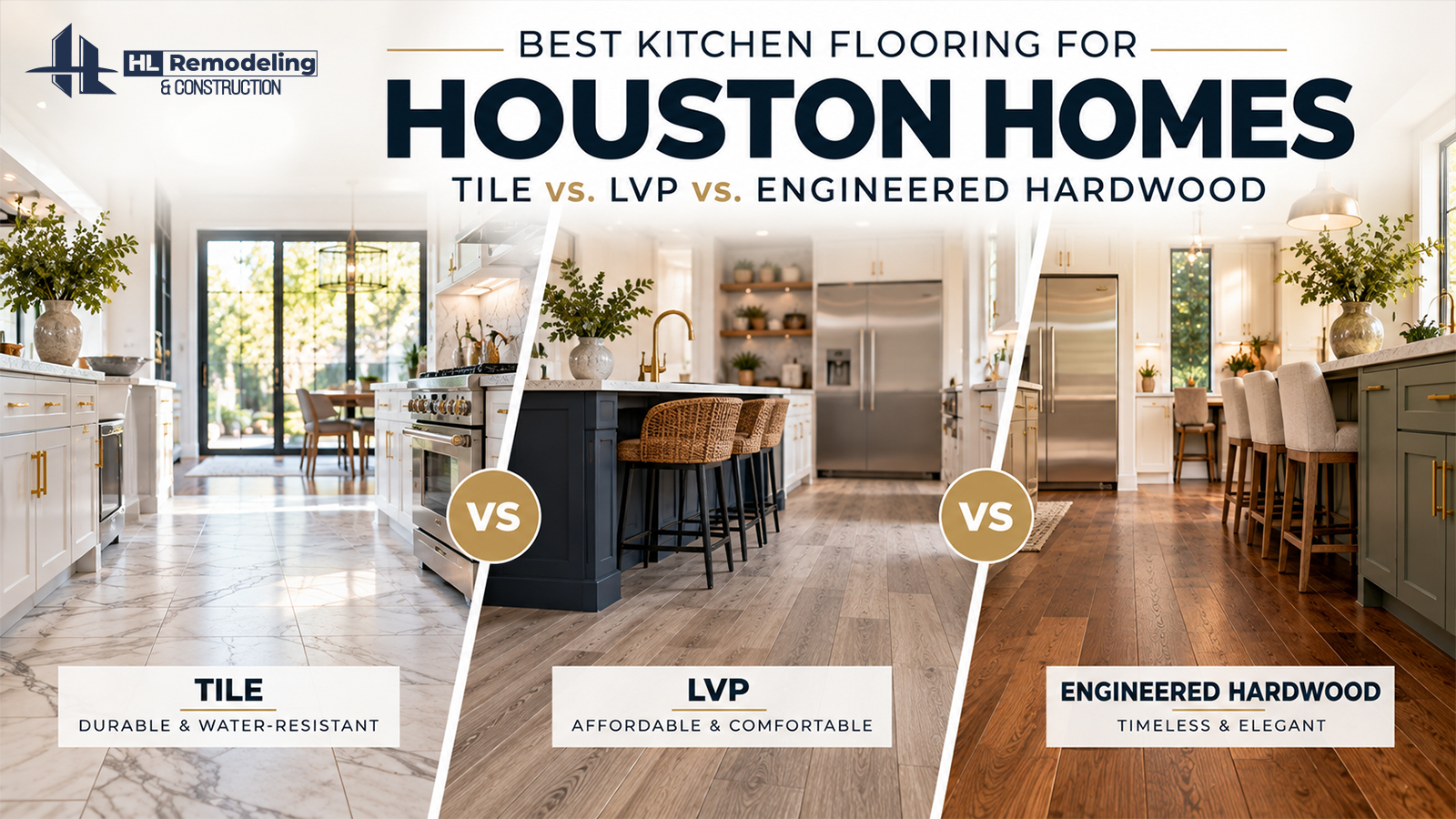
Kitchen flooring in Houston has to handle humidity, shifting clay soil, and storm season, and no single floor wins in every house. The best kitchen flooring for Houston homes depends on your house: porcelain tile fits flood-prone or slab homes, high-end luxury vinyl plank (LVP) fits budget and comfort goals, and engineered hardwood fits open-concept homes with strong moisture control. If you’re planning a full kitchen remodel, your slab, your flood exposure, and how you live in the room decide the winner, and we’ll show you how to tell which one is yours.
Key Takeaways
- Porcelain tile wins for flood-prone and slab homes, rigid-core LVP wins on budget and comfort underfoot, and engineered hardwood wins in open-concept homes with strong moisture control.
- Installed prices in Houston run roughly $4–9 per square foot for LVP, $6–15 for engineered hardwood, and $6–18 for porcelain tile, according to Houston installer cost guides.
- Every floor has one prep step you can’t skip: a moisture test for hardwood and LVP, a crack-isolation membrane under tile, and a 20-mil wear layer minimum on kitchen LVP.
- Match the floor to your flood exposure and slab condition first. Match the look second.
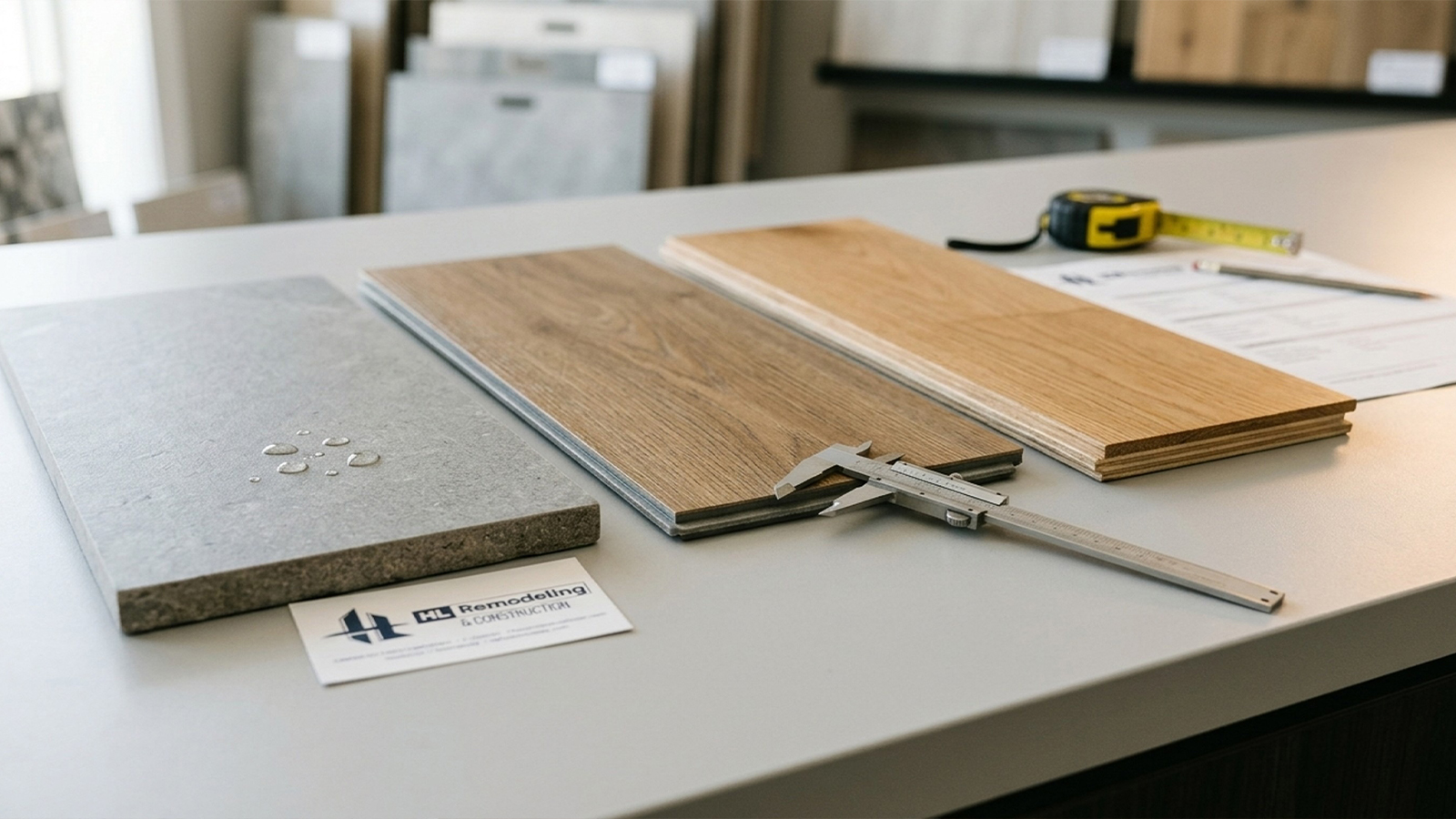
Is Tile or LVP Better for a Kitchen in Houston? Comparing All Three Floor Options
Porcelain tile is better for flood risk and long life, while LVP is better for cost, comfort, and forgiving installation. Engineered hardwood sits between them on price and gives you the warmest look. The table below shows how each one performs on the factors that matter most in a typical Houston kitchen.
| Factor | Porcelain Tile | Rigid-Core LVP | Engineered Hardwood |
|---|---|---|---|
| Installed cost per sq ft (Houston) | $6–18 | $4–9 | $6–15 |
| Water resistance | Excellent | Surface waterproof | Limited |
| Lifespan | 50+ years | 15–25 years | 20–40 years |
| Scratch and dent resistance | Very high | High with 20-mil wear layer | Moderate |
| Comfort underfoot | Hard and cold | Softer, quieter | Warm and firm |
| Resale appeal | Strong | Good | Strongest in warm-look homes |
| DIY-ability | Low | High | Low on slab |
Not sure which column fits your house? A quick look at your slab and your address on the flood map usually settles it, and we’re glad to walk through that with you.
Houston’s climate decides which floor survives
Houston summer humidity regularly tops 70 to 80 percent outside, while your A/C dries the air inside. That constant swing moves wood. It also pushes moisture up through slab-on-grade foundations, which is how most Houston homes are built. Whatever flooring type you pick has to handle moisture from below, and a hardwood floor feels it most because wood takes on and releases water with every seasonal swing.
The ground adds a second problem. Houston sits on expansive clay that swells when wet and shrinks in drought, and slab cracks are among the most common foundation issues in the area. A rigid tile floor sits right on top of that movement.
Flooding is the third factor. FEMA’s draft Harris County maps released in February 2026 would expand the 100-year floodplain by about 130 square miles, according to the Houston Chronicle. The maps are still draft and not regulatory. Check your address on the Harris County Flood Education Mapping Tool before you choose your kitchen floor.
Porcelain tile: the toughest option when water and slab movement are the concern
Porcelain tile shrugs off spills, pets, hot pans, and standing water. Look for a PEI rating of 3 or 4 for residential kitchens and a wet DCOF slip-resistance rating of 0.42 or higher under the ANSI A137.1 standard. Skip glossy, polished finishes. They look great, but they feel slick, and a slick kitchen floor is a safety risk.
The tradeoff is the slab. Tile cracks if the concrete underneath moves, so it needs a crack-isolation membrane. It also feels hard and cold underfoot, and a dropped glass rarely survives.
Is luxury vinyl plank waterproof enough for a kitchen that could flood?
Luxury vinyl plank is waterproof on the surface, but it is not flood-proof as a system. Rigid-core LVP planks survive spills and short exposure. Water that gets under the planks can stay trapped against the slab and grow mold, so the subfloor has to dry fast.
Core type matters. SPC (stone plastic composite) cores are denser and tougher on dents, while WPC (wood plastic composite) cores feel softer underfoot. Choose a wear layer of at least 20 mil for a kitchen, and look for FloorScore or GREENGUARD low-VOC certification. Laminate swells at the edges when wet, but a good rigid-core LVP holds its shape. In a mapped flood zone, we steer homeowners to porcelain tile or SPC LVP.
Can You Put Engineered Hardwood in a Kitchen in Houston’s Humidity?
Yes, with conditions. Engineered hardwood handles Houston better than solid hardwood, but only when the slab is dry and your indoor humidity stays controlled. Miss either one and the floor will cup or gap.
How engineered hardwood is built and why it beats solid hardwood on a slab
Engineered hardwood has a real wood veneer glued over a cross-ply core. That layered build resists the swelling and shrinking that wrecks solid wood. Solid planks are a single piece of wood, and on a Houston slab they absorb moisture from below and warp. Lines from Bruce, Mohawk, and Shaw are common in Houston showrooms, and warranty terms for kitchen use vary by line.
The veneer is real wood, not a photo. That’s why engineered wood keeps the look and resale pull of a hardwood floor. The thickness of that top layer decides how many times you can refinish it, so ask for the number before you buy.
The moisture limits that keep your warranty valid
The National Wood Flooring Association (NWFA) sets the testing rules. A slab should read 75 percent relative humidity or lower under the ASTM F2170 probe test, or 3 pounds or less under the ASTM F1869 calcium chloride test. Most makers also want indoor humidity held between 35 and 55 percent. Houston A/C can do that, but only if it runs year-round.
One Houston homeowner skipped the slab test to save a few hundred dollars. Within a year the boards cupped near the dishwasher, and the floor had to be torn out. A moisture test would have flagged the slab before install.
On a slab, glue-down installation is the usual method. Older pier-and-beam homes, like Heights bungalows, can often take nail-down floors if the crawlspace stays ventilated and dry. With steady humidity, a nail-down wood floor in one of those homes can last for decades.
Engineered hardwood vs. LVP for open-concept Houston homes
It comes down to how you live. Choose engineered hardwood when you want one continuous natural wood floor from kitchen to living room and you can control humidity. Choose LVP flooring when kids, dogs, and spills are daily events. Both read as wood from across the room, but only real hardwood veneer can be sanded and refinished.
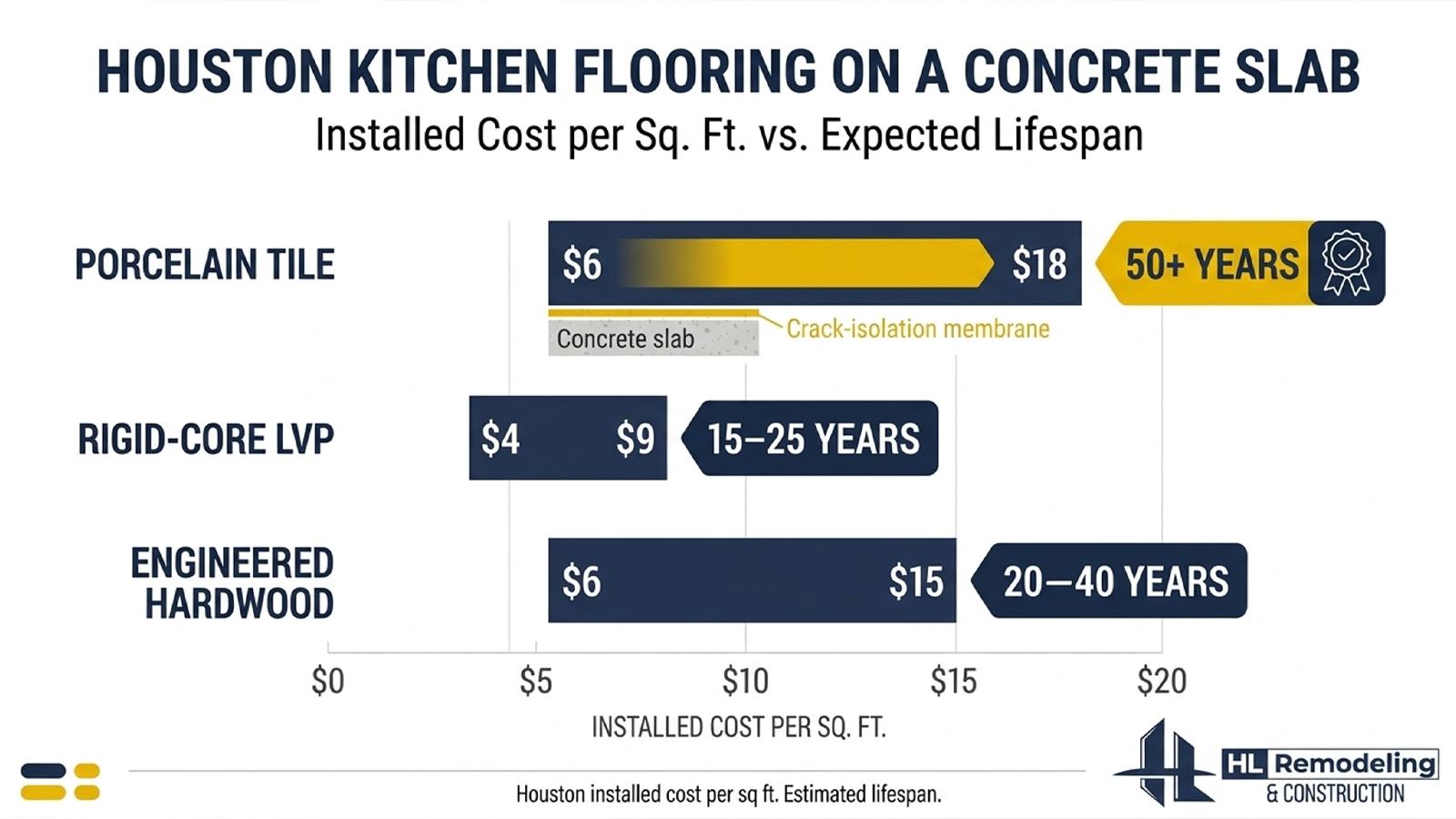
What Is the Most Durable Kitchen Floor on a Concrete Slab, and What Does It Cost in Houston?
Porcelain tile over a properly prepared slab is the most durable kitchen floor on concrete. Rigid-core LVP is a close second for moisture tolerance. Both fail early without prep.
Slab prep that prevents cracked tile and failed planks
Test the slab first, using a calcium chloride or in-slab RH test. For tile, install an uncoupling membrane such as Schluter DITRA, which lets the tile float over small slab cracks instead of snapping with them, following Tile Council of North America (TCNA) methods. LVP needs a flat slab and the right underlayment. Hardwood needs the moisture numbers above.
This is the line item cheap quotes leave out. We list moisture testing, leveling, and membranes in the written, itemized cost proposal, so prep never shows up later as a surprise invoice. If you’ve already collected a quote and want a second set of eyes on what it includes, bring it along and we’ll go through it line by line.
What kitchen flooring costs in Houston, line by line
A real flooring cost has more than the price on the plank. Installed price ranges come from Houston installer and retailer guides. Expect these line items:
- Material and installation: $4–9 per square foot for LVP, $6–15 for engineered hardwood, and $6–18 for porcelain tile.
- Demolition and haul-off of the old floor: about $1–4 per square foot.
- Subfloor prep, leveling, and moisture barrier: roughly $0.50–1.50 per square foot extra in Houston’s humidity.
- Trim, transitions, and baseboard: priced by the linear foot.
For a 200 square foot kitchen, that adds up to a wide range:
| Floor | Estimated Total (200 sq ft, installed with demo and prep) |
|---|---|
| LVP | $1,400–$3,400 |
| Engineered hardwood | $1,800–$5,400 |
| Porcelain tile | $1,800–$6,400 |
These are planning ranges, not quotes. Layout, tile size, and slab condition move the final number.
Does kitchen flooring affect resale value in Houston?
Yes. Buyers walk through a kitchen looking for floors that look current and hold up. A cracked, gapped, or worn floor drags down the whole room. In open plans, one continuous floor from kitchen to living area reads as higher-end. A real hardwood floor veneer helps, and clean porcelain tile in a neutral tone works too. We compare your plan to recent sales in your neighborhood so the floor fits what buyers there expect.
Choosing the Right Flooring for Your Houston Kitchen
Pick by scenario. If you’re in or near a flood zone, choose porcelain tile or SPC LVP. Pets and kids? LVP with a 20-mil wear layer. Entertaining in an open plan with a slab that tests dry? Engineered hardwood. If budget leads, choose LVP.
Houston homeowners repeat the same mistakes. They skip the slab moisture test. They buy glossy tile with a low DCOF rating. They pick LVP under 12 mil, or install tile without a crack-isolation membrane. Whatever the material, the floor installed without proper prep is the one that fails first.
Conclusion
Porcelain tile is the safest choice for flood-prone and slab homes. LVP is the practical choice for budget and comfort. Engineered hardwood rewards open-concept homes with dry slabs and steady humidity, and the right prep protects whichever one you pick.
The floor works best as one decision inside a larger remodel you can budget. We put floors, cabinets, and counters into one written, itemized cost proposal and show them together in 3D renderings before anything is installed, so you see your tile or plank next to your cabinets and counters before it goes down. Our owner stays in direct contact from the first rendering to the final walkthrough, so you know what’s happening before it happens. If you’re weighing tile, LVP, and engineered hardwood for your Houston kitchen, get a free consultation with us to talk through your floor, layout, and budget. You can reach us at (346) 837-0007.
FAQ
Is tile or LVP better for a kitchen in Houston?
Porcelain tile is better for flood-prone and slab homes, and LVP is better for budget and comfort. Tile lasts longer and ignores water. LVP costs less and feels softer underfoot. Either one fails without proper slab prep, which HL Remodeling handles as part of a written scope.
Can you put engineered hardwood in a kitchen in Houston’s humidity?
Engineered hardwood works in a Houston kitchen when the slab passes a moisture test and indoor humidity stays between 35 and 55 percent. The cross-ply core resists swelling far better than solid hardwood. Professional testing and glue-down installation protect your warranty.
What is the most durable kitchen flooring for a home with a concrete slab?
Porcelain tile over a crack-isolation membrane is the most durable kitchen flooring for a concrete slab. Schluter DITRA lets the tile float over small cracks from shifting clay. Where the membrane goes and how it’s set is where installer skill shows.
How much does it cost to install kitchen flooring in Houston?
Kitchen flooring in Houston costs roughly $4–9 per square foot for LVP, $6–15 for engineered hardwood, and $6–18 for porcelain tile, installed. Demolition adds $1–4 per square foot, and prep adds more. HL Remodeling puts every line in a written, itemized proposal.
Is luxury vinyl plank waterproof enough for a kitchen that could flood?
Luxury vinyl plank resists spills but is not flood-proof. Water trapped under planks can cause hidden subfloor mold, so the slab must dry quickly. For homes in mapped flood zones, porcelain tile or SPC LVP is the safer pick.
Does kitchen flooring affect resale value in Houston?
Kitchen flooring affects Houston resale value because buyers judge condition and continuity quickly. Real wood looks, durable porcelain tile, and one floor across an open plan all help. HL Remodeling compares your plan to recent neighborhood sales without promising a specific return.